

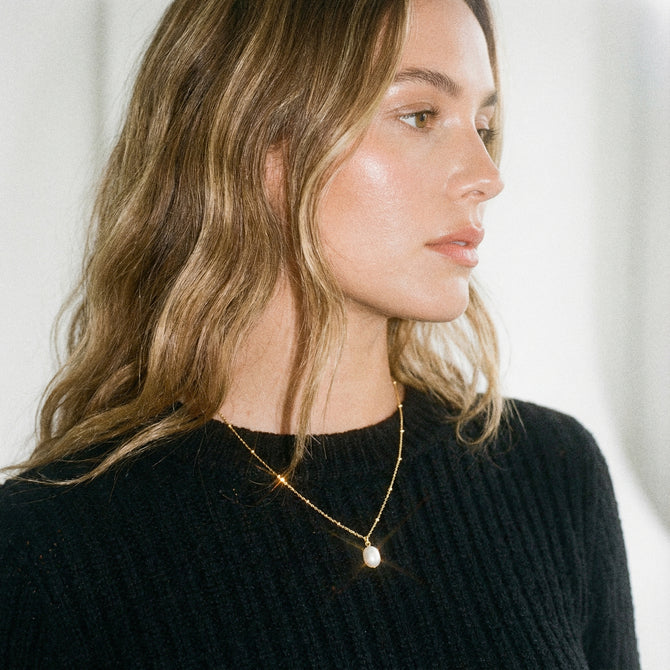

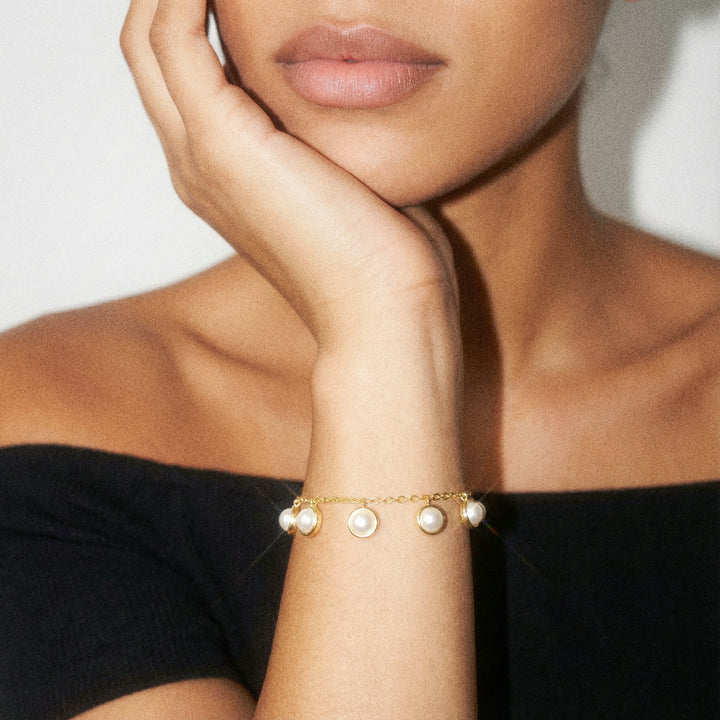



Selecting the ideal pearl shape can transform a garment. Ill-chosen embellishments often weigh fabric down, alter the drape or diminish its natural sheen. How can you choose pearls that flatter silk, crepe and satin while keeping attachments discreet and allowing the fabric to move freely?
This guide explains how to assess fabric weight, weave and sheen, how to match pearl size to the scale and proportions of a garment, and how to pair pearl shape with silk, crepe and satin to achieve harmonious movement and enhanced lustre. It also covers practical placement and fastening techniques, plus care routines designed to preserve longevity, minimise fuss and keep the finished piece effortlessly wearable.
![{"image_loaded": true, "load_issue": null, "description": "The image shows a close-up of a person\u2019s hands and a partially visible face. The person is holding a long pearl necklace, which drapes around the fingers of one hand. The person has fair skin and is wearing a cream-colored garment with intricate gold embroidery near the neckline. The lighting is warm and focused, creating shadows and emphasizing texture. The background is dark and out of focus, making the hands and pearls the main focal point. The camera angle is slightly below eye level and the composition centers on the hands and jewelry with the face softly blurred in the background.", "people": {"count": 1, "roles": ["model"], "visible_demographics": "approximate adult female, fair skin, partially visible face", "attire": "cream-colored garment with gold embroidery", "pose_or_activity": "holding and displaying a pearl necklace"}, "setting": {"environment_type": "indoor studio", "location_hints": "dark, blurred background, warm focused lighting", "depth_scale": "close-up", "lighting": "artificial, warm, directional spotlighting", "temperature": "warm"}, "objects": {"primary_objects": ["pearl necklace"], "secondary_objects": ["gold embroidered garment"], "object_interaction": "hands holding and arranging pearl necklace"}, "composition": {"subject_focus": "hands holding pearls in the center foreground, face in soft focus background", "relationships": "hands and pearls in sharp focus, face softly blurred behind", "depth_structure": "shallow depth of field, sharp on hands and pearls, blurred background", "camera_angle": "slightly low angle", "cropping": "close-up on hands and partial face"}, "motion": {"motion_type": "implied", "motion_direction": null, "energy_level": "low", "sequence_implied": "single moment"}, "aesthetic": {"medium": "photograph", "style_subtype": "realistic, stylized with selective focus", "color_palette": "warm and muted with creamy and gold tones", "contrast_level": "high", "texture_and_grain": "smooth skin and pearls contrasted with soft fabric texture", "postprocessing": "shallow depth of field, warm color grading"}, "tone": {"visual_mood": "elegant, intimate", "lighting_influence": "warm spotlight emphasizes texture and form", "camera_distance_effect": "intimate, detailed view"}, "confidence": {"demographic_confidence": 0.8, "activity_confidence": 0.9, "setting_confidence": 0.85}}](https://cdn.shopify.com/s/files/1/0371/8817/3961/files/image_loaded_true_load_issue_null_description_the_image_shows_a_close_up_view_of_a_person_s_hands_and_part_of_their_face_and_upper_torso_the_person_is_holding_a_long_string_of_white_p_4f9d8178-4597-476d-bb15-1ec4117520c5.webp?v=1770048336)
How to assess fabric weight, weave and sheen
Pin a pearl to a fabric swatch, view it in the lighting and at the distance you expect to wear it, and note whether it reads clearly or seems to vanish. Use those observations to select a shape and lustre that will perform in real conditions. Match the pearl profile to the fabric's weight and drape: favour low-profile, single-drop shapes for lightweight silks and fine crepes, and choose fuller shapes or multi-pearl arrangements for heavier satins and lined garments that can carry the weight. Let the weave guide you: textured crepes welcome irregular baroque forms, while smooth satins enhance symmetry so round or coin shapes become crisp focal points.
Scale pearl size and placement to the garment's lines and to the distance from which it will be viewed. For narrow collars, favour button or seed shapes; for thin straps, consider single drops; for wide necklines and roomy lapels, choose longer strands or larger coin pearls so proportions reinforce the silhouette. Plan attachments to keep fuss to a minimum by using flat-back settings or small, evenly spaced stitches, and add lightweight interfacing beneath delicate weaves to prevent puckering. Test the garment in motion to ensure pearls do not snag, weigh the fabric down, or alter the drape. If weight remains an issue, distribute several small pearls rather than a single large piece to preserve comfort and shape.
Add fine 4mm pearls for low-profile wearable elegance.
![{"image_loaded": true, "load_issue": null, "description": "A medium close-up shot of a young woman with dark curly hair and medium skin tone. She is seen in profile looking towards the left. Another person's hands, with long pale pink nails and silver rings, are holding and adjusting large, gold-toned earrings near her ear. The background is softly focused, suggesting an indoor setting with neutral tones.", "people": {"count": 2, "roles": ["model", "stylist or jewelry assistant"], "visible_demographics": "One young adult woman with medium skin tone and dark curly hair in profile; another person's hands visible with pale skin tone, fingernails manicured, and wearing rings.", "attire": "The model wears a black garment with a white cuff visible; the other person\u2019s attire is not clearly visible.", "pose_or_activity": "The model is tilting her head slightly to the side while the other person adjusts earrings near her ear."}, "setting": {"environment_type": "indoor", "location_hints": "neutral, softly focused background possibly in a boutique or dressing room; no distinct signage or decor visible", "depth_scale": "medium", "lighting": "soft, natural or diffused artificial light, even illumination", "temperature": "neutral"}, "objects": {"primary_objects": ["large gold-toned earrings", "blue and gold decorative earring accessory"], "secondary_objects": null, "object_interaction": "The hands are carefully holding and positioning the earrings near the woman's ear."}, "composition": {"subject_focus": "the woman's face and earrings near her ear, centered in the frame", "relationships": "the hands interact closely with the woman's ear area, creating focus on jewelry", "depth_structure": "shallow depth of field with blurred background", "camera_angle": "eye-level", "cropping": "medium close-up framing including face, ear, hair, and hands"}, "motion": {"motion_type": "implied", "motion_direction": null, "energy_level": "low", "sequence_implied": "single moment"}, "aesthetic": {"medium": "photograph", "style_subtype": "realistic, fashion portrait", "color_palette": "muted, neutral with accents of gold and blue", "contrast_level": "moderate", "texture_and_grain": "smooth, natural skin texture visible", "postprocessing": "natural color grading, minimal retouching"}, "tone": {"visual_mood": "calm, focused", "lighting_influence": "soft, even lighting", "camera_distance_effect": "intimate"}, "confidence": {"demographic_confidence": 0.9, "activity_confidence": 0.95, "setting_confidence": 0.8}}](https://cdn.shopify.com/s/files/1/0371/8817/3961/files/close_up_of_a_woman_trying_on_luxury_earrings_in_a_fashion_store_setting_SP5A7n2Qks.72l6pxaYP9.webp?v=1768458824)
Selecting the ideal pearl size to suit a garment's scale and proportions
Begin by measuring a dominant garment detail, such as a lapel, neckline or stripe, and select a pearl diameter equal to roughly one-eighth to one-sixth of that measurement so the pearl appears as a visible, balanced accent. For example, a 6 centimetre lapel typically pairs with pearls of about 0.75 to 1 centimetre across; this keeps them noticeable without overwhelming delicate silk or appearing too small against broader satin. Fabric surface alters perceived size: shiny satin reflects light and makes pearls appear larger, textured crepe mutes highlights so pearls seem smaller, and on lightweight, flowing silk slightly smaller pearls with secure settings will better maintain proportion and placement.
Consider size ranges in proportion to the garment rather than treating them as strict rules: small pearls complement narrow collars and delicate blouses; medium pearls suit standard dresses and blazers; larger pearls hold their own on wide lapels and full satin gowns. Check by pinning a sample pearl to a hanging fabric swatch, view it from the intended distance and photograph it in the garment's typical lighting, then adjust diameter or spacing until the pearl appears in proportion. Record the measurements and keep reference photographs or simple diagrams so you can reproduce the same scale and balance across other pieces.
Layer a fine strand of petite freshwater pearls.
![{"image_loaded": true, "load_issue": null, "description": "The image shows a close-up view of a person seated at a table or desk with makeup brushes and cosmetic palettes arranged on the surface. The person's arm is resting on the edge of the table, wearing a decorative bracelet with pearls and pink beads. The individual is dressed in a white satin or silk garment with feathered cuffs. Only the forearms and partial torso of the person are visible, with no facial features shown. The table surface is glossy black, reflecting some of the objects on it. The setting appears to be indoors with natural light coming from the left side, indicated by shadowing and reflections. The background includes a wooden floor and a fringed light-colored cushion or rug beneath the person.", "people": {"count": 1, "roles": ["individual"], "visible_demographics": null, "attire": "white satin or silk robe with feathered cuffs and decorative bracelet with pearls and pink beads", "pose_or_activity": "seated with arm resting on table edge, near makeup brushes"}, "setting": {"environment_type": "indoor", "location_hints": "table with makeup brushes and palettes, wooden floor, natural lighting from window, fringed cushion or rug", "depth_scale": "close-up", "lighting": "natural light from side", "temperature": "neutral"}, "objects": {"primary_objects": ["makeup brushes", "cosmetic palettes", "decorative bracelet"], "secondary_objects": ["table", "cushion or rug"], "object_interaction": "hand resting near or over table edge close to makeup items"}, "composition": {"subject_focus": "close-up on arm and table edge with makeup items", "relationships": "arm positioned diagonally across frame, makeup items arranged on table surface in background", "depth_structure": "limited depth of field with focus on bracelet and hand, background makeup items slightly out of focus", "camera_angle": "eye-level angle, slightly tilted down", "cropping": "tight crop on arm and part of torso, no face"}, "motion": {"motion_type": "static", "motion_direction": null, "energy_level": "low", "sequence_implied": "single moment"}, "aesthetic": {"medium": "photograph", "style_subtype": "realistic", "color_palette": "neutral tones with accents of pink and white", "contrast_level": "moderate", "texture_and_grain": "smooth with soft natural light highlights", "postprocessing": "natural, no heavy filters"}, "tone": {"visual_mood": "calm, elegant", "lighting_influence": "soft natural light creates gentle highlights and shadows", "camera_distance_effect": "intimate close-up view focuses attention on details of bracelet and makeup items"}, "confidence": {"demographic_confidence": 0.3, "activity_confidence": 0.8, "setting_confidence": 0.9}}](https://cdn.shopify.com/s/files/1/0371/8817/3961/files/close_up_of_a_woman_putting_on_a_bracelet_near_a_makeup_table_warm_tones_enhance_the_elegance_SP5A7n2Qks_1328abc9-9f84-401a-8d08-346e6fedf8cf.webp?v=1768199463)
How to pair pearl shapes with silk, crepe and satin
Select pearl shapes that mirror a fabric's drape and silhouette. Symmetrical round or near-round pearls complement smooth, structured satin; elongated drops and teardrops reflect silk's flowing movement; and irregular baroque pearls sit naturally within crepe's textured weave. Consider how surface interaction and scale affect the overall look. Satin's high sheen will amplify lustre and reveal any blemishes, while crepe's pebbled surface tends to soften and conceal irregularities. Lightweight silks work best with smaller pearls to avoid sagging or overpowering the garment. Whenever possible, test pearls against the actual fabric in natural light to observe how lustre, shadow and perceived contrast behave before committing to a placement.
Think carefully about fastenings, placement and movement to keep the overall look tidy. On slippery satin, use secure pins or short chains; on crepe, anchor pendants into seams or natural folds; and for pieces that will move, favour stud or screw-back attachments. Simulate typical motion to ensure the chosen shape and attachment remain in place and do not distort the garment's drape. Use overtone and colour to control prominence: warm overtones blend with warm fabrics, cool overtones stand out on cool-coloured satin, and a considered contrast can create a clear focal point. Always check combinations in both daylight and indoor lighting so you can judge how the pairings read across different settings.
Choose compact, secure pearls to preserve satin's drape.
![{"image_loaded": true, "load_issue": null, "description": "The image shows a close-up of a person's left ear with dark braided hair. The person is attaching or adjusting a dangling earring made of linked, oval-shaped elements with small sparkling stones, ending in a large white pearl. The person's fingers, with manicured nails painted a light pink or nude color, hold the earring. A silver ring with a round stone is visible on the right hand's ring finger. The background is neutral and out of focus.", "people": {"count": 1, "roles": ["customer", "model"], "visible_demographics": "Adult female with dark complexion and braided hair", "attire": null, "pose_or_activity": "Using hands to put on or adjust earring"}, "setting": {"environment_type": "indoor", "location_hints": "Neutral background, likely studio setting", "depth_scale": "close-up", "lighting": "soft, even, natural or studio lighting", "temperature": "neutral"}, "objects": {"primary_objects": ["dangling earring with pearl"], "secondary_objects": ["silver ring on finger"], "object_interaction": "Person's fingers holding and positioning the earring on the ear"}, "composition": {"subject_focus": "Ear and earring centered in frame", "relationships": "Hands close to ear holding earring", "depth_structure": "Shallow depth of field with ear and hands in sharp focus", "camera_angle": "Eye-level", "cropping": "Extreme close-up focused on ear and earring"}, "motion": {"motion_type": "implied", "motion_direction": null, "energy_level": "low", "sequence_implied": "single moment"}, "aesthetic": {"medium": "photograph", "style_subtype": "realistic", "color_palette": "muted and natural skin tones with sparkling highlights on jewelry", "contrast_level": "moderate", "texture_and_grain": "smooth skin texture, glossy finish on pearl and stones", "postprocessing": "minimal, natural color correction"}, "tone": {"visual_mood": "calm, elegant", "lighting_influence": "soft, diffused lighting enhances fine details", "camera_distance_effect": "intimate, highlighting detail"}, "confidence": {"demographic_confidence": 0.9, "activity_confidence": 0.95, "setting_confidence": 0.85}}](https://cdn.shopify.com/s/files/1/0371/8817/3961/files/effortless_everyday_styles_for_freshwater_pearl_earrings_SP5A7n2Qks.Gv6QdJ010P_7bf14507-ad00-4629-b5b0-28579b3a245f.webp?v=1772034210)
Position and secure pearls for fuss-free all-day wear
Match the attachment method to the fabric to protect its appearance and ensure longevity. Silk: Use fine silk or cotton thread and very small sew-through stitches. Pass the thread through each stitch twice and secure on the reverse to keep holes minimal and reduce stress on the fabric. Satin: Stitch through a small stabiliser placed behind the pearl to prevent slippage. Use delicate, closely spaced stitches so the pearl sits securely without disturbing the fabric's sheen. Crepe: Take slightly longer, evenly distributed stitches to accommodate the textured surface and avoid puckering. Whenever possible, anchor pearls to seams, facings or areas with underlining so the load is shared across layers and resists pull-through during wear. For very fragile weaves, baste a small circle of lightweight interfacing or a matching scrap behind the pearl and test the technique on a fabric scrap to confirm the backing remains invisible.
Leave a small shank beneath each bead to allow the fabric to move naturally. On the reverse side secure the thread with two locking half-hitches, then take a few catch-stitches before trimming; this reduces tension and makes future repairs simpler. Always trial the stitch, backing and spacing on a scrap, and launder or steam that sample in the same way the finished garment will be treated, adjusting your method as required. For on-the-spot repairs carry matching thread and a sharp needle, and if a pearl loosens re-seat it by stitching through the existing hole into the stabiliser rather than removing the bead.
Choose a secure, gold-finished pearl strand for lasting elegance.
![{"image_loaded": true, "load_issue": null, "description": "The image shows a close-up of a person's hand holding a small jewelry piece made of white beads connected by a gold-colored clasp. The background features a light wood surface with blurred white and gold decorative elements and other jewelry components scattered around.", "people": {"count": 1, "roles": ["hand model or jewelry maker"], "visible_demographics": null, "attire": null, "pose_or_activity": "Holding a small beaded jewelry piece delicately in fingers"}, "setting": {"environment_type": "indoor", "location_hints": "Light wooden table surface with jewelry-making supplies and decorative elements blurred in the background", "depth_scale": "close-up", "lighting": "soft, natural or diffused light", "temperature": "neutral"}, "objects": {"primary_objects": ["white bead jewelry piece with gold clasp"], "secondary_objects": ["decorative white and gold materials", "jewelry-making supplies"], "object_interaction": "Person's hand is holding the jewelry piece gently"}, "composition": {"subject_focus": "hand and jewelry piece in the right foreground", "relationships": "Hand is positioned towards the right side with blurred decorative elements in the background", "depth_structure": "shallow depth of field with focused hand and jewelry, blurred background", "camera_angle": "eye-level", "cropping": "tight close-up on hand and jewelry"}, "motion": {"motion_type": "static", "motion_direction": null, "energy_level": "low", "sequence_implied": "single moment"}, "aesthetic": {"medium": "photograph", "style_subtype": "realistic", "color_palette": "muted, neutral tones with white and gold accents", "contrast_level": "moderate", "texture_and_grain": "smooth, soft focus background", "postprocessing": "soft blur on background, natural color grading"}, "tone": {"visual_mood": "calm, delicate, refined", "lighting_influence": "soft and diffused lighting for gentle tone", "camera_distance_effect": "intimate and detailed focus on hand and jewelry"}, "confidence": {"demographic_confidence": 0.5, "activity_confidence": 0.9, "setting_confidence": 0.8}}](https://cdn.shopify.com/s/files/1/0371/8817/3961/files/upload_91d16cce-8f73-4f16-92a5-69020bbf59e9.webp?v=1765437251)
How to care for pearls to preserve their lustre, movement and longevity
After wearing, gently wipe pearls with a soft, slightly damp cloth to remove skin oils, perspiration and hair products. Allow them to air dry flat before returning them to a breathable pouch. Oils and acids from skin and cosmetics dull the nacre and can cause discolouration, so removing residues promptly helps preserve their lustre. For a deeper clean, use a mild pH-neutral soap with a soft cloth or a soft-bristled brush. Do not use ultrasonic cleaners, steam, household chemicals or abrasive products, as these can delaminate or erode the nacre.
Knot between each pearl and restring when necessary to preserve a fluid drape, prevent rubbing and reduce the risk of losing multiple beads if the thread fails. Inspect strands for signs of fraying, loosened drill holes, stiffness or restricted movement, and seek professional repair at the first sign of damage. When attaching pearls to silk, crepe or satin, stitch from the reverse with a fine needle and a strong, flexible thread, leaving a small loop or a single loose stitch so each pearl can swing freely. Use a lightweight backing behind crepe to reduce abrasion. Store pearls separately from other jewellery, either flat or on a soft hanger according to strand length, and rotate wear to avoid prolonged exposure to perspiration.
Selecting pearl shapes that complement a fabric's weight, weave and lustre helps preserve a garment's drape and accentuate its silhouette. Test on swatches, scale the size of pearls to key areas, and use secure, discreet anchoring with a lightweight backing to achieve wearable, effortless results.
Follow the headings: assess fabric, match size, pair shape, position and care to move clearly from selection to attachment. Carry out simple trials, choose suitable fastenings and maintain the piece regularly to preserve its lustre, simplify future repairs and ensure the finished piece is comfortable and ready to wear.