






Pearl necklaces can give little warning: a fraying thread or a slack knot after years of wear may herald the loss of a pearl. Knowing when to restring is not always straightforward unless you can recognise the subtle signs of wear.
This step-by-step inspection checklist explains how to identify signs of wear, prepare your workspace and tools, and assess threads, knots, clasps and fittings. Use it to decide whether a simple repair will suffice or if professional restringing or complete replacement is the wiser option.
![{"image_loaded": true, "load_issue": null, "description": "A rear view of a woman holding a small handheld mirror reveals her reflection focusing on her neck and lower face. The woman is wearing a double-strand pearl necklace and a matching pearl bracelet. The background is a solid dark blue color. The image is softly lit, emphasizing the smooth skin tones and the glossy texture of the pearls.", "people": {"count": 1, "roles": ["model"], "visible_demographics": "adult female, skin tone medium, exact ethnicity not discernible", "attire": "pearl necklace and matching pearl bracelet, no clothing visible from this angle", "pose_or_activity": "holding a handheld mirror and looking at her reflection"}, "setting": {"environment_type": "studio", "location_hints": "solid dark blue background, neutral controlled lighting", "depth_scale": "close-up", "lighting": "soft, diffused studio lighting", "temperature": "neutral"}, "objects": {"primary_objects": ["handheld mirror", "double-strand pearl necklace", "pearl bracelet"], "secondary_objects": null, "object_interaction": "woman holds mirror to observe her pearl necklace"}, "composition": {"subject_focus": "reflected neck and lower face centered in handheld mirror frame", "relationships": "mirror reflection aligned with woman's position, pearls emphasized", "depth_structure": "shallow depth of field with blurred shoulder and mirror handle foreground", "camera_angle": "eye-level from behind the woman", "cropping": "close-up focusing on the mirror reflection"}, "motion": {"motion_type": "static", "motion_direction": null, "energy_level": "low", "sequence_implied": "single moment"}, "aesthetic": {"medium": "photograph", "style_subtype": "minimalist, elegant", "color_palette": "muted with dark blue background and natural skin tones", "contrast_level": "moderate", "texture_and_grain": "smooth skin and glossy pearl texture", "postprocessing": "soft focus, subtle color grading"}, "tone": {"visual_mood": "calm, refined, sophisticated", "lighting_influence": "soft and even, highlights pearls and skin", "camera_distance_effect": "intimate and focused"}, "confidence": {"demographic_confidence": 0.7, "activity_confidence": 0.9, "setting_confidence": 0.8}}](https://cdn.shopify.com/s/files/1/0371/8817/3961/files/image_loaded_true_load_issue_null_description_the_image_shows_a_woman_holding_a_hand_mirror_in_which_the_lower_part_of_her_face_and_neck_are_reflected_she_is_wearing_a_double_strand_p_4027225d-01af-4697-ae3e-8d1807305850.webp?v=1772639373)
How to recognise when your pearls need restringing
Carefully inspect each knot and the connecting silk or fibre for fraying, thinning, discolouration or stiffness. Gently lift the strand to check for uneven spacing or gaps between pearls, which often indicate separating fibres. Hold the necklace beneath a bright light and rotate it slowly to reveal scratches, pits or dull spots where adjacent pearls rub. Visible loss of nacre at these contact points indicates abrasive wear. Together, these signs point to a compromised thread and the need to restring the pearls to prevent further surface damage.
Drape the necklace over a finger to observe how the pearls fall; if they slide too freely, clink together, or make a clicking sound when gently shaken, the thread may have lost secure tension, increasing the risk of sudden break. Examine metal fittings for looseness, corrosion or bending, and check that the end knots or crimps holding the clasp are secure, as a weakened clasp concentrates stress on the strand. Look for residue from perspiration or perfume and any yellowing; note stiffness or discolouration. Stained or brittle fibres indicate chemical or environmental weakening, so visible contamination is a prompt to clean the strand and consider restringing.
Choose a restrung strand with a secure silver clasp.
![{"image_loaded": true, "load_issue": null, "description": "A middle-aged woman with light skin and blonde hair is holding a string of large white pearls. She is wearing a white satin or silk blouse with a pointed collar and pearl earrings. The scene appears indoors with neutral tones in the background. A bouquet of white and dark pink flowers is visible in the foreground to the right, and a glass dish and red grapes are partially visible at the bottom near the woman's hands. The image focuses on the woman's upper body and hands, with a shallow depth of field, making her face softly blurred and the pearls and hands sharply focused.", "people": {"count": 1, "roles": ["wearer", "model"], "visible_demographics": "middle-aged woman, light skin", "attire": "white satin or silk blouse, pearl earrings", "pose_or_activity": "holding and inspecting a string of large white pearls"}, "setting": {"environment_type": "indoor", "location_hints": "neutral background, floral arrangement, glass dish, grapes on table", "depth_scale": "medium", "lighting": "soft, diffused, indoor lighting", "temperature": "neutral"}, "objects": {"primary_objects": ["string of large white pearls"], "secondary_objects": ["white and dark pink flowers", "glass dish", "red grapes"], "object_interaction": "woman holding and inspecting the pearl necklace"}, "composition": {"subject_focus": "woman's hands and pearls in center foreground; blurred face in background", "relationships": "pearls prominently positioned between hands, flowers to side", "depth_structure": "shallow depth of field with blurred background", "camera_angle": "eye-level", "cropping": "medium shot focusing mainly on upper body and hands"}, "motion": {"motion_type": "implied", "motion_direction": null, "energy_level": "low", "sequence_implied": "single moment"}, "aesthetic": {"medium": "photograph", "style_subtype": "realistic", "color_palette": "muted, neutral tones with soft whites and creams", "contrast_level": "moderate", "texture_and_grain": "smooth, soft focus on background", "postprocessing": "light retouching with soft focus effect"}, "tone": {"visual_mood": "calm, refined, elegant", "lighting_influence": "soft and diffused lighting creates a gentle tone", "camera_distance_effect": "intimate due to medium close-up on hands and pearls"}, "confidence": {"demographic_confidence": 0.9, "activity_confidence": 0.8, "setting_confidence": 0.85}}](https://cdn.shopify.com/s/files/1/0371/8817/3961/files/sophisticated_mature_woman_examining_pearl_necklace_at_an_elegant_table_setting_SP5A7n2Qks_ddebce85-47d8-44b7-ab66-0fed264cd35a.webp?v=1768113374)
Prepare a calm workspace and gather the right inspection tools
Begin by stabilising a soft, non-abrasive surface and organising a shallow, compartmentalised tray. Position a neutral white light to reveal subtle surface defects and shifts in colour. With clean, dry hands or lint-free finger cots, gently wipe each pearl with a soft cloth to remove oils, cosmetics and any grit that can mask scratches or discolouration. Use magnification, such as a jeweller's loupe or a strong magnifying glass, to inspect drill holes, hairline cracks, surface pitting and any thinning of the nacre. Rotate each bead under the light to catch worn spots that only appear at certain angles.
Keep a small selection of gentle, non-destructive tools to hand, such as soft-tipped tweezers or a blunt probe, to test knot security, thread slack and whether knots shift or fray without harming the pearls. Apply light tension along the strand to reveal any stretch or weak points, and check for residue or damaged drill holes that may indicate imminent failure. Photograph any areas of concern, note clasp condition and knot spacing, and keep a short checklist so you can compare future inspections and make an evidence-based decision about whether to restring.
Switch to classic pearl studs for everyday, low-maintenance wear
![{"image_loaded": true, "load_issue": null, "description": "The image shows a close-up view of two women seated at a white marble table inspecting pieces of gold and coral-colored jewelry, including a necklace and a ring. The women are partially visible from the shoulders down to their hands, one with blonde hair wearing a white jacket and the other with brown hair and a beige and white outfit. In the background, shelves display pairs of shoes and a brown shopping bag, suggesting a boutique or showroom setting. The lighting is natural and soft, creating a bright atmosphere with minimal shadows.", "people": {"count": 2, "roles": ["customer", "sales associate or customer"], "visible_demographics": "Two adult women, one with blonde hair and one with brown hair, exact ages not determinable.", "attire": "One woman wears a white jacket, the other wears a beige sweater and white shirt.", "pose_or_activity": "Both seated, focused on examining jewelry with their hands."}, "setting": {"environment_type": "indoor", "location_hints": "Shelves with shoes and shopping bag in the background, marble table surface, boutique or showroom environment.", "depth_scale": "close-up", "lighting": "natural, soft, and bright", "temperature": "neutral"}, "objects": {"primary_objects": ["gold necklace", "gold ring", "coral-colored beads"], "secondary_objects": ["marble table", "shopping bag", "pair of shoes on shelves"], "object_interaction": "Both women holding and inspecting jewelry pieces on the table."}, "composition": {"subject_focus": "Hands and jewelry positioned centrally on the marble table, women's torsos partially visible at the top edge of the frame.", "relationships": "Jewelry laid out on table in foreground, women closely examining items.", "depth_structure": "Shallow depth with focus on hands and jewelry, background items softly out of focus.", "camera_angle": "eye-level, slightly angled downwards.", "cropping": "close-up framing focusing on hands and jewelry."}, "motion": {"motion_type": "implied", "motion_direction": null, "energy_level": "low", "sequence_implied": "single moment"}, "aesthetic": {"medium": "photograph", "style_subtype": "realistic", "color_palette": "muted neutrals with gold accents", "contrast_level": "moderate", "texture_and_grain": "smooth and clear", "postprocessing": "natural lighting enhancement"}, "tone": {"visual_mood": "calm and focused", "lighting_influence": "bright and evenly lit, enhancing product details", "camera_distance_effect": "intimate and detailed view"}, "confidence": {"demographic_confidence": 0.8, "activity_confidence": 0.9, "setting_confidence": 0.85}}](https://cdn.shopify.com/s/files/1/0371/8817/3961/files/upload_cd12483b-bad7-434d-b077-dc9ff27f7697.webp?v=1765437334)
How to inspect threads and knots for wear and damage
To decide whether a necklace needs restrining, hold it up to a bright light and examine the thread between each pearl for fraying, thinning, discolouration or dark patches. These signs often point to trapped oils or grit and can precede breakage. Gently run the strand between thumb and forefinger while supporting a pearl to detect any roughness, stiffness or gritty resistance. A gritty or brittle feel usually indicates embedded dirt or fibre breakdown rather than surface grime alone. Use a loupe or close-up photographs to record subtle changes and monitor their progression over time.
Inspect each knot carefully. Use a fingernail to test for compression, splitting or looseness, and gently tug each pearl against the adjacent knots to confirm they do not slide or unravel. Drape the necklace and pay particular attention to stress points by the clasp and any pendant attachments; look for uneven knot spacing, stretched thread or sudden gaps, as these areas often show the first signs of wear. Note the thread type as you examine the piece: natural silk typically fuzzes and darkens with age, while synthetic fibres are more likely to abrade or stretch. Matching these visual signs to their likely causes will help you assess the necklace's condition accurately.
Opt for a freshly strung grey-pearl strand
![{"image_loaded": true, "load_issue": null, "description": "The image shows a person in a white outfit holding a string of large pearls, with one hand wearing a white glove and the other hand a black prosthetic hand. The person is partially visible, focusing mainly on their hands and the lower part of their face. An open book is in the foreground, slightly out of focus, placed on a white surface. The background is black, providing high contrast to the subject.", "people": {"count": 1, "roles": ["individual handling pearls"], "visible_demographics": "adult with light skin tone, feminine presentation", "attire": "white blouse or light garment with an open neckline, gold necklace with a heart pendant, white glove on one hand", "pose_or_activity": "holding and examining a pearl necklace using gloved hand and prosthetic hand"}, "setting": {"environment_type": "indoor", "location_hints": "table with open book, dark background", "depth_scale": "medium", "lighting": "soft, diffused lighting focused on hands and pearls", "temperature": "warm"}, "objects": {"primary_objects": ["pearl necklace", "black prosthetic hand", "white glove", "open book"], "secondary_objects": ["gold necklace with heart pendant"], "object_interaction": "person's gloved hand and prosthetic hand are holding and touching the pearl necklace"}, "composition": {"subject_focus": "centered on the hands holding the pearls", "relationships": "hands in close proximity, pearls draped between them, book in the foreground", "depth_structure": "shallow depth of field with hands and pearls in sharp focus, background and book blurred", "camera_angle": "eye-level", "cropping": "close-up on hands and partial face"}, "motion": {"motion_type": "static", "motion_direction": null, "energy_level": "low", "sequence_implied": "single moment"}, "aesthetic": {"medium": "photograph", "style_subtype": "realistic, soft-focus", "color_palette": "muted, warm tones with high contrast black background", "contrast_level": "moderate", "texture_and_grain": "smooth, soft textures", "postprocessing": "likely color grading for warmth and softness"}, "tone": {"visual_mood": "calm, intimate, refined", "lighting_influence": "soft and warm lighting adds gentle mood", "camera_distance_effect": "intimate, focusing on small details like hands and pearls"}, "confidence": {"demographic_confidence": 0.8, "activity_confidence": 0.9, "setting_confidence": 0.85}}](https://cdn.shopify.com/s/files/1/0371/8817/3961/articles/an_elegant_woman_with_a_prosthetic_arm_holding_pearls_captured_in_soft_lighting_creating_a_sophisticated_futuristic_mood_SP5A7n2Qks_6cf1652d-0a50-4e4d-a643-956caa41a5e4.webp?v=1767102639)
Inspect clasps and metal fittings for signs of wear
Gently open and close the clasp, observing for wobble, sticking or uneven action. A clasp that moves loosely or fails to snap securely under light movement is at risk of accidental release. Inspect solder joints and jump rings with a loupe and bright, even light, looking for hairline cracks, thinning metal or tiny gaps at the joins. Apply gentle tension to any joins that appear compromised to check whether they will hold, and note any component that deforms or shifts under such a small load.
Check metal parts and the adjacent silk for corrosion, discolouration or greenish staining, since metal migration onto the thread or pearls indicates a chemical attack that can weaken fittings and abrade fibres. Run the metal fittings gently over the pearls and the silk, feeling for burrs, rough edges or raised seams. Any sharpness that catches the nacre is a sign the fittings could damage pearls or cut the thread. Compare metal types and the condition of the plating across the piece, because worn plating, exposed base metal or mixed metals in contact can accelerate wear or cause galvanic corrosion and may justify replacing fittings when restringing.
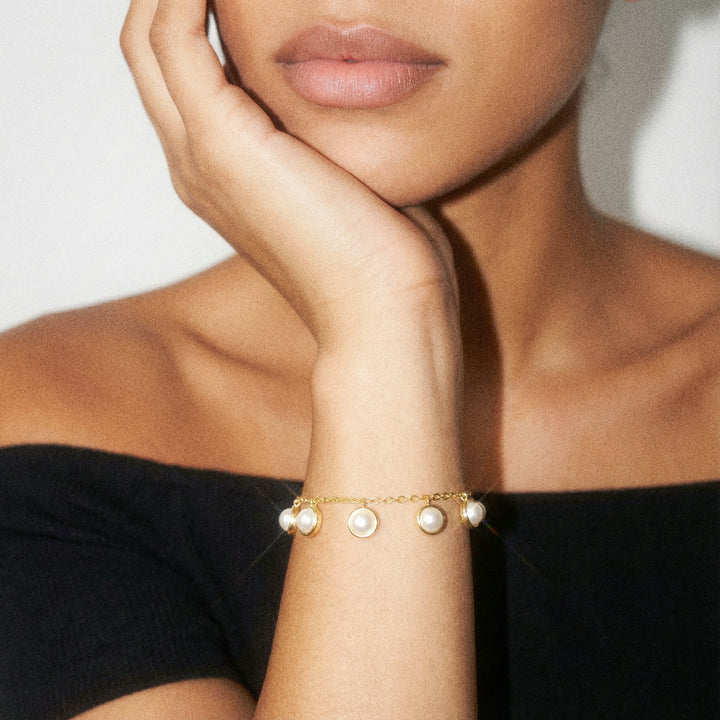
Opt for a secure, gold-plated pearl bracelet.
![{"image_loaded": true, "load_issue": null, "description": "An older man with gray hair viewed from behind is examining objects on a wooden desk using a magnifying loupe eyeglass. He is dressed in a white shirt and dark vest. The desk has various small tools and items typically associated with detailed craftsmanship or inspection, including small containers and pencils, scattered across a light wooden surface. The lighting is warm and focused, illuminating the workspace.", "people": {"count": 1, "roles": ["craftsman", "inspector"], "visible_demographics": "older adult male with gray hair", "attire": "white shirt under dark vest", "pose_or_activity": "looking through a magnifying loupe eyeglass at objects on the desk"}, "setting": {"environment_type": "indoor workspace or workshop", "location_hints": "wooden desk, small tools and craftsman-related items, warm lighting", "depth_scale": "medium", "lighting": "warm, focused on workspace", "temperature": "warm"}, "objects": {"primary_objects": ["magnifying loupe eyeglass", "small containers", "tools", "pencils"], "secondary_objects": ["desk items", "paper or workspace mat"], "object_interaction": "man is closely inspecting objects on the desk using magnification"}, "composition": {"subject_focus": "man\u2019s head and hand inspecting objects in foreground", "relationships": "foreground man with tools on desk in immediate workspace", "depth_structure": "shallow depth of field with blurred background", "camera_angle": "slightly elevated over the shoulder", "cropping": "close-up framing focusing on man\u2019s head, hand, and desk area"}, "motion": {"motion_type": "static", "motion_direction": null, "energy_level": "low", "sequence_implied": "single moment"}, "aesthetic": {"medium": "photograph", "style_subtype": "realistic", "color_palette": "muted, natural tones", "contrast_level": "moderate", "texture_and_grain": "smooth", "postprocessing": "natural lighting, possibly minor color correction"}, "tone": {"visual_mood": "focused, professional", "lighting_influence": "warm and directed", "camera_distance_effect": "intimate, detailed view"}, "confidence": {"demographic_confidence": 0.9, "activity_confidence": 0.85, "setting_confidence": 0.9}}](https://cdn.shopify.com/s/files/1/0371/8817/3961/files/senior_watchmaker_carefully_examining_a_timepiece_with_a_loupe_in_workshop_SP5A7n2Qks.72l6pxaYP9.webp?v=1770652029)
Repair, professional restringing or replacement: how to decide
Carefully inspect the thread under a loupe with good directional light, looking for fraying, discolouration, sagging, widened gaps between knots, dirt packed into drill holes, or flattened and slipping knots, as several of these signs point to full restringing rather than a simple repair. Gently drape the strand, slide the beads side to side, then apply a light tug at the centre and near both ends to reveal wobble, sudden movement or hidden weak points. If knots slip or beads move freely when tested, arrange for re-knotting or complete restringing rather than a surface fix.
Examine each pearl under angled light for chips, hairline cracks, thinning nacre, irregular diameters or loss of lustre. Note that wear around the drill hole alone can often be resolved by restringing, whereas cracked or severely abraded beads will usually need replacement. Inspect the clasp, jump rings and end fittings for deformation, corrosion or insecure joins, and consider whether replacing the findings would restore safe wearability. If the string or knots are compromised, prioritise restringing over hardware repairs, since a new clasp will not remedy a weakened strand. For heirloom pieces, items with strong provenance or strands that retain many original knots, document the piece and seek advice from a conservator or pearl specialist; a well preserved strand with only one or two loose knots may be suitable for local repair and re-knotting.
Regular inspection, supported by a methodical checklist, helps you identify fraying, thinning threads and faults in fittings before a pearl is lost. Recording the condition of threads, the security of knots, wear around drill holes and the integrity of clasps provides clear criteria for deciding between local repair, professional restringing or replacement of individual beads.
Use a clear step-by-step checklist that applies careful lighting, magnification, gentle tension and photographic records to assess risk and determine the best course of action. By following these steps and recording your findings, you preserve the pearls and their provenance and can proceed with confidence when restringing or conserving.