

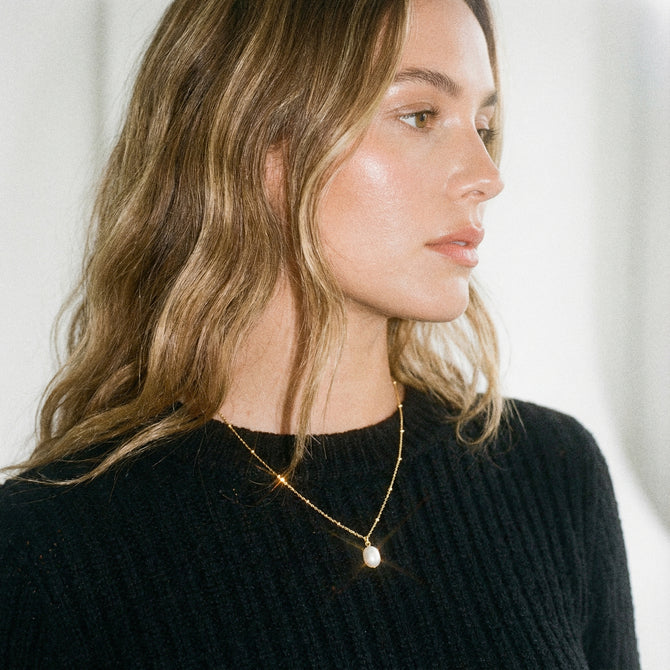
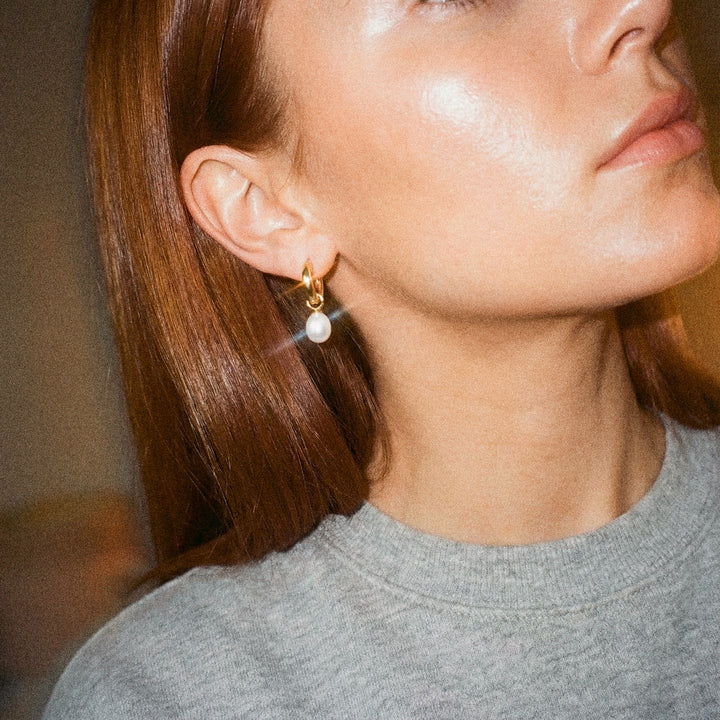
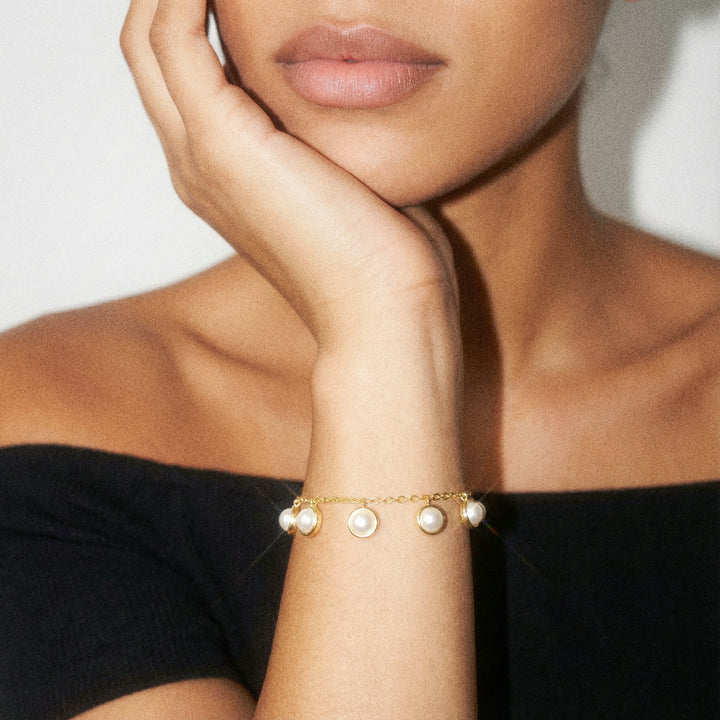
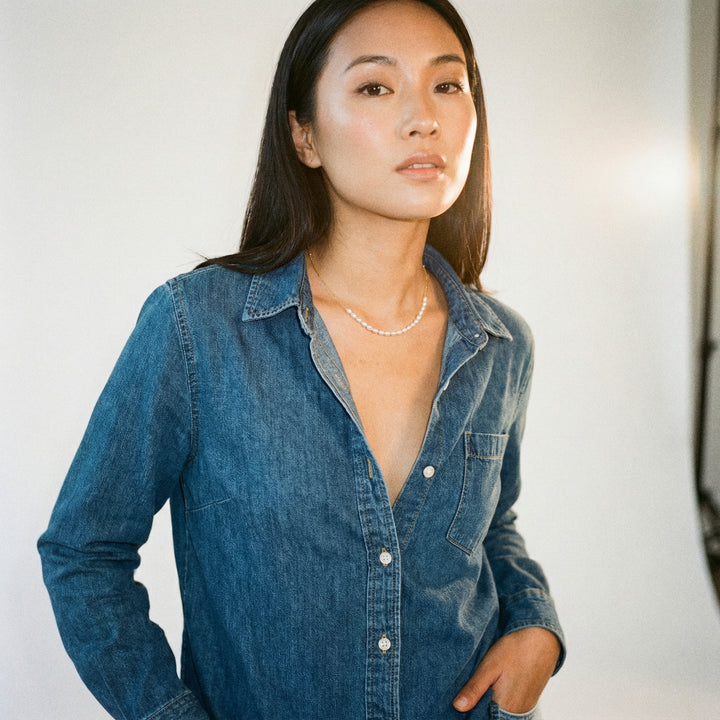


Ever notice how a necklace can disappear against a textured top, or how a pendant can overwhelm a delicate dress? Smaller pearls may be lost in heavy knits, whereas larger, more lustrous pearls can balance a coarser weave, so choose size, shape, colour and placement with care.
This guide explains how to assess fabric texture and visual weight, match pearl proportions to fabric scale, and harmonise colour and lustre to create a balanced contrast. It also covers choosing length and placement to flatter different necklines, and layering pearls with other jewellery so textured outfits feel intentional and cohesive.
![{"image_loaded": true, "load_issue": null, "description": "The image shows a close-up view of the lower face and neck of a person with light skin and curly blonde hair. They are wearing red lipstick and a layered pearl necklace. Another person's hands are visible, adjusting the necklace or clothing. The background is blurred with two warm round lights. The person wears a black garment and the second person is partially visible, wearing dark clothing and a black hat.", "people": {"count": 2, "roles": ["primary subject", "person adjusting necklace"], "visible_demographics": "Two adults, light skin tones; one with blonde curly hair, red lipstick, the other partially visible with dark hair and dark clothing", "attire": "The primary subject wears a black garment and layered pearl necklaces; the secondary person wears a black hat and dark clothing", "pose_or_activity": "Primary subject is standing still; secondary person is adjusting the necklace or garment on the primary subject"}, "setting": {"environment_type": "indoors or dimly lit area", "location_hints": "Blurred warm round lights in the background suggest an indoor or evening setting", "depth_scale": "close-up", "lighting": "soft, warm lighting, likely artificial", "temperature": "warm"}, "objects": {"primary_objects": ["layered pearl necklace"], "secondary_objects": ["black garments"], "object_interaction": "One person is adjusting the pearl necklace or garment on the primary subject"}, "composition": {"subject_focus": "neck and lower face of the primary subject", "relationships": "hands of secondary person interacting closely with necklace and shoulder of primary subject", "depth_structure": "shallow depth of field with blurred background", "camera_angle": "eye-level, close-up", "cropping": "cropped to lower face, neck, and shoulders"}, "motion": {"motion_type": "implied", "motion_direction": null, "energy_level": "low", "sequence_implied": "single moment"}, "aesthetic": {"medium": "photograph", "style_subtype": "realistic, stylized portrait", "color_palette": "muted with warm highlights", "contrast_level": "moderate", "texture_and_grain": "smooth skin texture, soft focus background", "postprocessing": "subtle color grading for warmth"}, "tone": {"visual_mood": "intimate, elegant", "lighting_influence": "soft and warm lighting enhances a cozy tone", "camera_distance_effect": "intimate, close framing creates focus on detail and touch"}, "confidence": {"demographic_confidence": 0.7, "activity_confidence": 0.8, "setting_confidence": 0.6}}](https://cdn.shopify.com/s/files/1/0371/8817/3961/files/description_the_image_shows_a_close_up_side_view_of_a_person_with_light_curly_hair_and_red_lipstick_wearing_a_black_outfit_another_person_s_hands_are_seen_fastening_or_adjusting_a_pea.webp?v=1767970763)
Assessing fabric texture and visual weight for cohesive styling
Start by measuring the dominant element of the fabric, whether a knit stitch, weave repeat or pile height. Compare pearl sizes at roughly half to equal that measurement to judge scale. Harmonise or provide contrast through surface finish: place high-sheen pearls against matte or brushed fabrics to create a clear focal point, or choose smaller, lower-lustre pearls to sit quietly with glossy silks and satins. Hold strands at different lengths against the actual collar, lapel or neckline to see whether they sit on top of the texture or disappear into folds. Shorter pieces read more clearly with busy textures, while longer strands suit open, draped silhouettes.
Account for weight and drape by choosing lighter, more flexible strands for soft, flowing garments so the jewellery does not pull or alter the silhouette. For heavier or more structured fabrics, opt for spaced or knotted designs to prevent pearls from sagging into seams or stitches, and observe how the strand behaves in motion. View pearls against the garment in varied lighting to judge how their warmth or coolness and reflective sheen work with the fabric's shadows and highlights. Use those observations to match tonal quality rather than colour alone, since warm-toned pearls soften brushed, earthy textiles while cool-toned pearls sharpen smooth, crisp surfaces.
Choose a delicate, lightweight strand for soft, flowing fabrics.
![{"image_loaded": true, "load_issue": null, "description": "Two women are in a well-lit interior space that appears to be a fashion design studio or boutique. One woman, standing upright, wears a mustard-colored dress and beige high-heeled sandals, while the other woman, bent forward slightly, measures the first woman's arm with a measuring tape. She is wearing a cream-colored dress and pointed beige shoes. Behind them are mannequins draped with fabric and open shelving units storing various items. Natural light from a window illuminates the space.", "people": {"count": 2, "roles": ["model", "fashion designer or tailor"], "visible_demographics": "One appears to be an Asian female adult, the other a Black female adult.", "attire": "The standing woman wears a mustard dress and beige sandals; the measuring woman wears a cream dress and beige pointed shoes.", "pose_or_activity": "One stands still holding a green object; the other leans forward to measure the arm of the standing woman."}, "setting": {"environment_type": "indoor", "location_hints": "Shelving with storage boxes, black mannequins, dress fabrics, window with natural light, light grey floor, modern furniture and fixtures.", "depth_scale": "medium", "lighting": "natural light coming from a window plus some artificial lighting", "temperature": "neutral"}, "objects": {"primary_objects": ["measuring tape", "black mannequins", "storage boxes", "fabric swatches"], "secondary_objects": ["green object held by standing woman", "shelves", "table with lamp and desk items"], "object_interaction": "The woman with braided hair uses the measuring tape on the arm of the other woman."}, "composition": {"subject_focus": "Centered on the two women interacting in the middle of the frame.", "relationships": "Designer is closely measuring while model remains still; mannequins and shelves frame the background with depth.", "depth_structure": "Moderate depth with clear foreground subjects and visible background elements.", "camera_angle": "Eye-level", "cropping": "Full body included for both women"}, "motion": {"motion_type": "implied", "motion_direction": null, "energy_level": "low", "sequence_implied": "single moment"}, "aesthetic": {"medium": "photograph", "style_subtype": "realistic", "color_palette": "muted and neutral tones", "contrast_level": "moderate", "texture_and_grain": "smooth", "postprocessing": "natural colors, minimal editing"}, "tone": {"visual_mood": "professional, calm", "lighting_influence": "bright natural lighting creates a clear, focused tone", "camera_distance_effect": "intimate, detailed enough to focus on interaction and clothing details"}, "confidence": {"demographic_confidence": 0.9, "activity_confidence": 0.95, "setting_confidence": 0.9}}](https://cdn.shopify.com/s/files/1/0371/8817/3961/files/upload_cb83e800-a48f-4ebc-aee9-3d706c44d44f.webp?v=1765400998)
How to match pearl size and shape to fabric scale
A simple rule of thumb is to match pearl diameter to the visual scale of the fabric. For very fine silks and lace choose pearls of around or under 6 mm so they do not pull or overpower the drape. For medium-weave shirts and blouses 6 to 9 mm reads clearly without dominating. For chunky knits, tweed or denim opt for 10 mm or larger so the pearls hold their own against pronounced texture. Consider shape in relation to structure. Near-perfectly round pearls echo clean, tailored surfaces, while baroque pearls introduce an organic counterpoint to structured suiting or boucle. Elongated rice or stick pearls complement vertical ribs or pleats, since shape directs the eye and influences perceived harmony. Plan proportion through placement and strand density. Pair delicate fabrics with single, short strands or widely spaced pearls to preserve movement. For coarser textures choose clustered, multi-strand arrangements or larger single strands so the jewellery remains visible and balanced.
Protect delicate weaves by considering both weight and method of attachment. Heavy or oversized pearls can stretch or pucker lightweight fabrics, so reinforce with a lightweight backing, favour sewn-on clusters rather than single heavy drops, or choose hollow constructions when available to help preserve the neckline. Always test before finishing. Pin sample pearls at the intended distance from the face, photograph them in natural light from the typical viewing positions, and compare how size, shape and lustre sit against the fabric's texture. Small pearls can disappear against dense weaves, while high-lustre pearls will create attractive highlights on matte surfaces. Use these observations to adjust size, shape, placement and attachment so the finished piece balances harmony and contrast while protecting the garment.
Choose 4mm pearls to preserve delicate fabrics.
![{"image_loaded": true, "load_issue": null, "description": "A young woman is shown from the chest up in a close medium shot. She has dark hair pulled back and is wearing makeup including eyeliner and lipstick. She wears a light gray, fuzzy button-up cardigan sweater. She has multiple pieces of jewelry: pearl and gold bead bracelets on her left wrist, a gold necklace with a pearl pendant, multiple earrings including a gold hoop with small pearls, and a small nose ring. Her left hand is resting on her chest, displaying neatly manicured nails in a natural nude color. The background shows an indoor architectural setting with stone walls, large glass panels, and metal structural elements, lit by natural light from the left side.", "people": {"count": 1, "roles": ["model"], "visible_demographics": "young adult female", "attire": "light gray fuzzy cardigan sweater", "pose_or_activity": "posing with left hand resting on chest, looking to left"}, "setting": {"environment_type": "indoor", "location_hints": "stone walls with columns, large glass panels, metal framing, natural lighting", "depth_scale": "medium", "lighting": "natural, soft light from left", "temperature": "neutral"}, "objects": {"primary_objects": ["gold and pearl jewelry including necklace, earrings, bracelets", "light gray fuzzy cardigan sweater"], "secondary_objects": null, "object_interaction": "wearing jewelry and sweater; left hand touching chest to display bracelets and manicure"}, "composition": {"subject_focus": "centered slightly left", "relationships": "left hand placed on chest showing jewelry", "depth_structure": "shallow, background softly out of focus", "camera_angle": "eye-level", "cropping": "close medium shot, chest and head framed"}, "motion": {"motion_type": "static", "motion_direction": null, "energy_level": "low", "sequence_implied": "single moment"}, "aesthetic": {"medium": "photograph", "style_subtype": "realistic", "color_palette": "muted, neutral", "contrast_level": "moderate", "texture_and_grain": "soft textures in clothing, smooth skin tones", "postprocessing": "natural color grading, slight sharpening"}, "tone": {"visual_mood": "calm, polished, elegant", "lighting_influence": "soft natural lighting enhances details and warmth", "camera_distance_effect": "intimate but not overly close"}, "confidence": {"demographic_confidence": 0.9, "activity_confidence": 0.95, "setting_confidence": 0.85}}](https://cdn.shopify.com/s/files/1/0371/8817/3961/files/IMG_6858_2.jpg?v=1763549306)
Harmonise colour and lustre to create balanced contrast
Match pearl size to the scale of the fabric. Very small pearls work beautifully with lightweight, finely textured fabrics; medium pearls suit mid-weight materials; larger pearls hold their own beside chunky knits or heavy weaves. Let lustre determine emphasis: high-lustre pearls act as focal points against matte or coarse textures, while lower-lustre, satiny pearls sit quietly alongside glossy or finely woven materials. Assess colour temperature and overtone in natural light, as warm overtones brighten earthy palettes while cool overtones harmonise with jewel tones.
Balance busy textures by layering pieces in varying lengths. If a garment has heavy texture below the neckline, place a single strand or pendant close to the face to draw the eye upward. Collar-length or multi-strand necklaces can anchor plainer tops, while staggered lengths and sizes prevent visual crowding and keep the look refined. Match metal findings and fastenings to the outfit's hardware and mood: warm metals complement rustic, tactile fabrics, while cooler tones suit sleek materials. Ensure clasps and overall weight feel proportionate to the garment. Photograph the complete look from several angles to check how pearls sit and whether the fabric pulls or distorts. Often a small adjustment to length, scale or metal is enough to create a deliberate, balanced contrast between jewellery and wardrobe.
Wear a single gold-suspended pearl to elevate textured fabrics.
![{"image_loaded": true, "load_issue": null, "description": "The image shows a close-up view of the lower face, neck, and upper chest of a single person wearing multiple layered necklaces. The focus is on the jewelry and the upper part of a green garment with a white floral pattern. The necklaces include a string of large white pearls, a thin chain with small gold beads, a black cord with a green stone pendant, and another delicate chain.", "people": {"count": 1, "roles": null, "visible_demographics": "One person, female presentation, adult, partial face visible", "attire": "Green and white floral patterned blouse with a deep neckline", "pose_or_activity": "Static, head slightly turned to the left"}, "setting": {"environment_type": "indoor", "location_hints": null, "depth_scale": "close-up", "lighting": "soft, natural or diffused lighting", "temperature": "neutral"}, "objects": {"primary_objects": ["pearl necklace", "black cord necklace with green stone pendant", "gold chain necklace with small beads"], "secondary_objects": null, "object_interaction": "The necklaces are layered around the person's neck, resting on the skin and garment"}, "composition": {"subject_focus": "centered on the layered necklaces and garment", "relationships": "necklaces layered closely together on chest area", "depth_structure": "shallow depth of field with background softly blurred", "camera_angle": "eye-level, slight left profile", "cropping": "close-up from upper chest to just below nose"}, "motion": {"motion_type": "static", "motion_direction": null, "energy_level": "low", "sequence_implied": "single moment"}, "aesthetic": {"medium": "photograph", "style_subtype": "realistic", "color_palette": "muted, natural tones, green, white, gold accents", "contrast_level": "moderate", "texture_and_grain": "smooth, soft focus", "postprocessing": "subtle color grading for warmth and clarity"}, "tone": {"visual_mood": "calm, refined, natural", "lighting_influence": "soft lighting enhances texture and detail of jewelry and fabric", "camera_distance_effect": "intimate, focused on detail"}, "confidence": {"demographic_confidence": 0.8, "activity_confidence": 0.9, "setting_confidence": 0.7}}](https://cdn.shopify.com/s/files/1/0371/8817/3961/files/upload_a1565f4c-a8c2-434f-89cb-b688aa03dff9.webp?v=1764786805)
Choose the right pearl length and placement to flatter your neckline
Hold a sample strand of beads against the garment in natural light to assess visual weight. If the beads disappear into the fabric, choose a larger size; if they overpower delicate lace, opt for a smaller one. Try different lengths from the front to see how short, mid and long pieces frame high necklines, fill scoop or square cuts, or trace a plunging V, and photograph each view to compare the negative space they create. These tests help you judge visual balance rather than rely on rules of thumb.
Anchor the focal point where the fabric is least busy: place the lowest bead or pendant over the largest area of uninterrupted material so the pearls read as a clear point of interest. On garments with uneven texture, shift the necklace slightly off centre to balance heavier panels. When layering, vary lengths by at least two finger-widths and mix small and larger pearls. Allow longer strands to sit over chunky knits to create gentle vertical lines, and stagger spacing so beads do not fall on the same plane as fabric ridges. Choose diameter and length to flatter the wearer by considering neck width, jawline and shoulder line. Fasten the necklace, stand naturally and check whether the lowest bead rests at the jawline, collarbone or torso to find the most harmonious proportion.
Try an 18-inch pearl strand for effortless layering.
![{"image_loaded": true, "load_issue": null, "description": "Close-up image of a person's chest and neck area showing a white blouse with intricate lace detailing around the collar. The person has long brown wavy hair falling on either side. They are wearing two necklaces: one is a string of pearls and the other is a gold chain with a pendant. The background is dark and out of focus.", "people": {"count": 1, "roles": null, "visible_demographics": "one person, likely adult female based on visible features", "attire": "white blouse with detailed lace collar", "pose_or_activity": "stationary, not engaged in any visible activity"}, "setting": {"environment_type": null, "location_hints": null, "depth_scale": "close-up", "lighting": "warm, soft, likely natural or diffused lighting", "temperature": "warm"}, "objects": {"primary_objects": ["white blouse with lace collar", "pearl necklace", "gold necklace with pendant"], "secondary_objects": null, "object_interaction": null}, "composition": {"subject_focus": "centered on neckline and upper torso with focus on blouse collar and necklaces", "relationships": "hair frames the clothing and jewelry symmetrically", "depth_structure": "shallow depth of field with blurred background", "camera_angle": "slightly low or straight on close-up", "cropping": "close-up image focusing on chest and neckline"}, "motion": {"motion_type": "static", "motion_direction": null, "energy_level": "low", "sequence_implied": "single moment"}, "aesthetic": {"medium": "photograph", "style_subtype": "realistic", "color_palette": "muted warm tones", "contrast_level": "moderate", "texture_and_grain": "soft texture with visible fabric detail", "postprocessing": "warm color grading with soft focus"}, "tone": {"visual_mood": "calm, elegant", "lighting_influence": "warm and soft lighting creates intimate, gentle tone", "camera_distance_effect": "intimate, focused on detail"}, "confidence": {"demographic_confidence": 0.8, "activity_confidence": 0.9, "setting_confidence": 0.4}}](https://cdn.shopify.com/s/files/1/0371/8817/3961/files/close_up_of_a_woman_wearing_a_white_lace_blouse_with_pearl_necklace_and_gold_pendant_SP5A7n2Qks.webp?v=1767076226)
Layer pearls with other jewellery for a cohesive, effortless look
Match pearl scale to fabric weight. Choose larger pearls around 8 to 12 mm for chunky knits, mid sizes of 4 to 8 mm for tailored wools and cottons, and smaller pearls of 2 to 4 mm for silk, lace or fine jersey. When layering, favour an odd number of strands and stagger their lengths so visible strands sit at least 4 to 6 cm apart. Vary chain thickness so each piece remains distinct against the texture and is less likely to tangle. Position a higher-contrast or larger piece near the face to draw the eye, and alternate smooth pearls with matt, hammered or beaded textures to add depth without competing with bold fabrics.
Create cohesion among mixed materials by repeating a single metal colour or a small pendant across layered necklaces; this links chains, beads and pearls without appearing overly matched. Use silicone stoppers or short connectors to keep strands aligned, and wear the complete outfit while moving to check for shifting or any rubbing from textured outer layers. Adjust spacing and pendant placement so the focal piece sits closest to the face and the overall silhouette remains clear. Have pearls restrung and polished as required to maintain their drape and sheen, as careful maintenance preserves how they sit against textured garments.
Select pearls that complement the fabric, visual weight and neckline so the jewellery feels integrated with the outfit rather than fading away or dominating it. Consider scale, lustre, colour temperature and placement, and hold a strand against the garment in natural light to choose the size, shape and length that strike the right balance between harmony and contrast.
Follow the practical checks in this guide: assess the dominant fabrics, hold sample strands against the garments and photograph them from typical viewing angles to refine your choices. Make small adjustments to spacing, length and metal finishes until the pearls sit comfortably and the overall silhouette feels intentional and harmonious.