



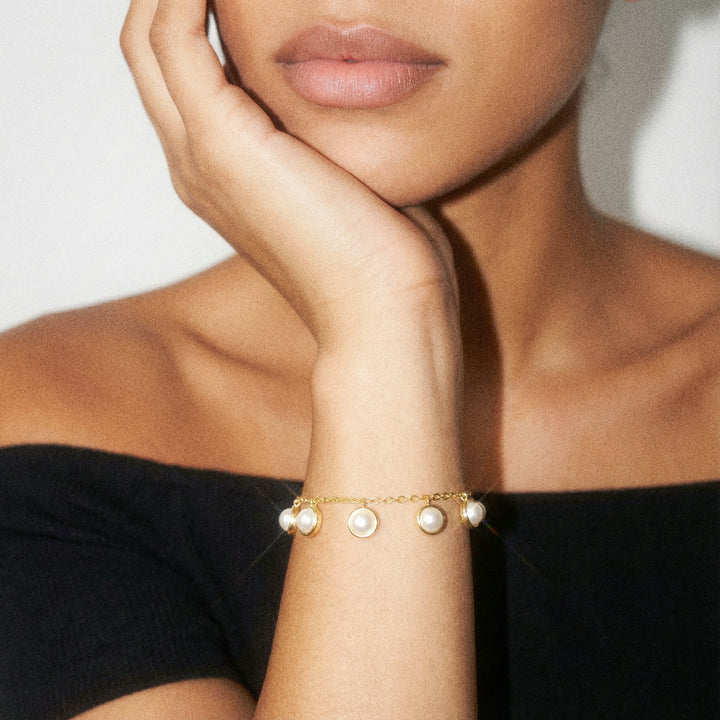



While pearls are often regarded as delicate, thoughtfully selecting the right size, shape, nacre and setting ensures you can enjoy their timeless elegance with comfort and ease every day.
This guide explores the distinctions between freshwater and saltwater pearls, offering insight into selecting the ideal size and shape for versatile jewellery. It also discusses how to appreciate the nuances of nacre, lustre, and surface quality. In addition, you will find guidance on choosing enduring settings, complementary metals, and ensuring a harmonious fit and comfortable weight, so your pearls remain a refined choice for everyday wear.
![{"image_loaded": true, "load_issue": null, "description": "Close-up image of a woman with blue eyes wearing a pearl necklace and a black top. She is holding part of the necklace with her left hand. The background is plain gray. She has light skin, light brown hair styled back with black feathers as decoration, and is wearing an earring. The lighting is soft and diffuse, highlighting her facial features and the pearls' luster.", "people": {"count": 1, "roles": ["model"], "visible_demographics": "Adult woman,](https://cdn.shopify.com/s/files/1/0371/8817/3961/files/image_loaded_true_load_issue_null_description_close_up_image_of_a_woman_with_blue_eyes_wearing_a_pearl_necklace_and_a_black_top_she_is_holding_part_of_the_necklace_with_her_left_hand_165cff72-8e70-4735-ad83-49e704c41a01.webp?v=1772120538)
Freshwater vs Saltwater Pearls: What Sets Them Apart?
Freshwater pearls are typically formed without a bead nucleus, resulting in solid nacre throughout that often appears thicker and more substantial. In contrast, many saltwater pearls are bead nucleated, which can give an initial surface radiance but sometimes leads to a more delicate nacre layer. To assess nacre quality, gently hold a bright light to the drill hole and rotate the pearl; a visible dark centre or notable transparency may indicate a thinner nacre. Freshwater pearl cultivation offers a broad spectrum of shapes, from near-round to beautifully baroque, lending themselves to relaxed, asymmetric, or pendant-focused designs. Saltwater pearls, by comparison, are more often found in consistently round forms, ideal for creating uniform strands or elegantly fitted collars.
Size and weight influence both comfort and movement: freshwater pearls are typically found in smaller to medium sizes, lending necklaces and bracelets a lightness suited to everyday elegance. Certain saltwater varieties, with their larger and heavier pearls, can create a more pronounced drape but may feel weightier across extended wear. When assessing a strand, observe the consistency of surface and the distribution of colour; freshwater pearls often display subtle texture and nuanced overtone variations, lending each piece unique character. Saltwater strands are prized for their harmonious colour and refined uniformity, ideal for those favouring minimalist designs. Before selecting a piece, consider practical elements such as drill hole diameter, thread type, and clasp compatibility, and gently mimic everyday gestures—such as turning your head or tucking your hair—to identify any areas of friction. Pearls with a thicker nacre are generally more resilient, accommodating larger drill holes and repeated restringing, making them especially suitable for pieces intended for frequent wear or occasional resizing.
Adds minimalist pearl elegance to everyday wear.

Selecting Pearl Sizes and Shapes for Effortless Versatility
Selecting the ideal pearl size is a subtle art. Choose dainty pearls measuring 3 to 5 millimetres for understated studs or delicate layering. Pearls of 6 to 8 millimetres offer graceful versatility, well suited to everyday necklaces and earrings. For a touch of drama, pearls in the 9 to 12 millimetre range create an elegant focal point, as their presence is naturally more striking. Round and near-round pearls present a harmonious symmetry and luminous sheen, while drop and button shapes echo the line of a neckline with gentle sophistication. Baroque pearls introduce texture and movement for a uniquely expressive touch. Those with a delicate frame or a preference for higher necklines may find smaller pearls particularly flattering, while larger pearls can beautifully complement open necklines or broader shoulders. To envisage the effect, place a paper circle or your fingertip near your collarbone to appreciate how the pearl size harmonises with your features and attire.
Create refined everyday combinations by layering a graduated strand, where delicate pearls sit gracefully near the collarbone and larger pearls drape lower for subtle contrast. Alternatively, pair petite stud pearls with a singular, more pronounced pendant to achieve a harmonious balance between understated charm and striking elegance. When selecting pieces for daily wear, consider comfort and practicality—substantial or unusually shaped pearls can catch on fabrics or add noticeable weight, while smaller, more rounded pearls offer effortless wearability and require minimal upkeep. Try on your chosen jewellery with your regular attire to ensure smooth movement and avoid potential snags. It is wise to check the condition of stringing and clasps from time to time, and to favour streamlined settings that safeguard the lustrous pearl surface, preserving both comfort and resilience for your everyday treasures.
Layer delicate 4mm pearls for effortless daily elegance.
![{"image_loaded": true, "load_issue": null, "description": "The image shows a close-up section of a person\u2019s upper chest, neck, and hair. The person is wearing a white garment with a V-shaped neckline and a string of white pearls around their neck. Dark hair partially covers the neck and shoulder area. The background is blurred and neutral.", "people": {"count": 1, "roles": ["individual model"], "visible_demographics": "One adult person, gender presentation appears female, skin tone light to medium.", "](https://cdn.shopify.com/s/files/1/0371/8817/3961/files/image_loaded_true_load_issue_null_description_the_image_shows_a_close_up_section_of_a_person_u2019s_upper_chest_neck_and_hair_the_person_is_wearing_a_white_garment_with_a_v_shaped_nec_e90a9f0c-964a-4298-bb59-946f045bc2d3.webp?v=1772120547)
How to Recognise Quality in Pearls: Nacre, Lustre and Surface
To assess lustre, gently hold a pearl near a plain surface and observe the reflection. A sharp, mirror-like highlight suggests closely layered nacre, while a diffused or chalky appearance may indicate nacre that is thinner or more worn. For nacre thickness, examine the area around the drill hole or base; signs such as a visible dark core, concentric layers, or translucent edges in strong light can point to finer nacre, whereas an opaque, rich surface implies greater depth and durability. When examining surface quality, a 10x loupe can help reveal natural features such as small pits, subtle scratches, or delicate growth lines. Minor imperfections on the reverse or side are typically less significant than more prominent marks on the main surface, reflecting the natural formation of each unique pearl.
Observe pearls in natural daylight to appreciate their orient and the depth of their colour; pearls displaying shifting, multi-hued reflections and an inner glow are often a testament to fine structure. Those with flat, single-colour reflections may offer less visual intrigue. For jewellery intended for regular wear, prioritise pieces with a thick nacre and a pronounced lustre, and seek information or certification regarding nacre thickness when possible. A gentle polish with a soft cloth can help confirm the surface’s integrity, as quality pearls should not flake or powder. Note the size and placement of any natural blemishes to assist in comparing individual pieces. Careful documentation of your observations ensures you can select pearls that suit both your aesthetic and lifestyle needs.
Opt for convertible huggies for versatile, lustrous everyday wear.

Selecting Enduring Settings and Metals for Effortless Everyday Elegance
Selecting the appropriate metal for everyday jewellery is essential; alloys with a sturdier composition, such as certain forms of gold or platinum, offer enduring shape and help safeguard pearls against everyday knocks. Opting for considered settings—like bezel cups, closed-back mounts, or low-set halo designs—provides delicate protection for the pearl, while also ensuring comfort and ease of wear. These thoughtful choices help preserve the beauty of the nacre and contribute to a timeless, effortless elegance suitable for daily adornment.
Opt for secure attachment techniques that a skilled jeweller can maintain over time, such as threaded posts, peg-and-adhesive settings where the peg rests within a precisely drilled pearl, or fully rimmed cups that provide greater stability than glue alone and can be re-pegged when necessary. When considering materials, select hypoallergenic alloys like platinum, palladium, or high-purity gold to help minimise the risk of irritation, bearing in mind that plated finishes may naturally wear and reveal the underlying metal, which can affect both appearance and comfort. Design with longevity in mind by favouring thicker shanks, soldered chain links, and settings with accessible prongs or cups. These thoughtful details enable a jeweller to re-tip prongs, re-polish surfaces, or re-set pearls as part of regular care, helping to preserve the piece’s elegance for years to come.
Choose low-profile huggies for secure, everyday pearl wear
![{"image_loaded": true, "load_issue": null, "description": "The image shows a woman holding a hand mirror in which the lower part of her face and neck are reflected. She is wearing a double-strand pearl necklace and a matching pearl bracelet. The background is plain and dark blue. The woman is seen from behind, with her bare shoulders and dark hair visible.", "people": {"count": 1, "roles": ["individual viewer"], "visible_demographics": "Adult female, medium skin tone, dark hair pulled back", "attire": "No c](https://cdn.shopify.com/s/files/1/0371/8817/3961/files/image_loaded_true_load_issue_null_description_the_image_shows_a_woman_holding_a_hand_mirror_in_which_the_lower_part_of_her_face_and_neck_are_reflected_she_is_wearing_a_double_strand_p_b7721501-d9d7-4ea1-8fa4-b55af065c3db.webp?v=1772120556)
How to Ensure Your Jewellery Feels Effortlessly Comfortable
Secure the strand and observe how it complements various necklines, both seated and standing. Take note of the position of the lowest pearl in relation to collars and natural folds, as a strand that slips beyond the neckline or frequently catches may disrupt everyday elegance. Gently rotate the necklace to the front to assess clasp balance; if the clasp drifts from its place, the strand may hang unevenly. Consider adjusting the clasp or selecting one that fastens securely and sits flush, ensuring it is comfortable to open and close single-handedly. Examine the tension, spacing, and knotting along the strand: knots should separate each pearl, allowing for an even and graceful drape, while adjacent pearls should not slide past one another when softly pulled. An uneven or loose tension can affect how the piece rests and may increase the risk of abrasion and wear over time.
To gauge the weight of a jewellery piece, gently try it on and notice any signs such as a subtle pull at the neck, slight indentations, or pressure on the earlobe. Take note if your hair becomes caught or if your posture feels altered, as these may suggest the design is less suited for prolonged wear. Mimic natural movements—bend, turn, reach, or lift your arms—to observe whether pearls softly brush against the skin or fabric, or whether a bracelet shifts or restricts your wrist. If you notice persistent rubbing, tangling, or the need to frequently adjust the piece, consider altering the fit or selecting a lighter, more balanced design, ensuring continued comfort throughout your day.
Selecting pearls for everyday wear involves a thoughtful balance of size, shape, nacre thickness, and setting, each contributing to both comfort and enduring beauty. Examine the nacre closely—prefer pearls with a rich, lustrous coating and choose settings that offer both subtlety and protection. When trying on pieces, consider how they complement your typical wardrobe, noting the feel, weight, and how the clasp sits, ensuring each detail enhances your sense of effortless elegance throughout the day.
When comparing strands, studs, and pendants, consider the nuances of freshwater and saltwater origins, as well as details such as size, shape, nacre, lustre, settings, and fit. Look for pearls with luminous depth, crisp reflections, secure mountings, and a graceful drape, ensuring that each piece maintains its beauty and elegance with everyday wear.