



Layering necklaces and stacking bracelets can elevate an outfit, but if spacing and balance are off they can appear cluttered. Have you ever selected several favourite pieces only to find they tangle, vie for attention, or sit awkwardly on the neck or wrist?
This guide explains how to assess proportion and scale, evaluate length, pearl size, clasps and drape, and position pendants so each element contributes to a cohesive rhythm. It also offers practical spacing techniques for stacking bracelets, creating breathing space, and harmonising colour, texture, movement and comfort across the neck and wrist, so every combination feels intentional.
![{"image_loaded": true, "load_issue": null, "description": "A woman wearing a white crocheted top is seen holding strands of pearl necklaces. She has light brown hair with gold hair clips and wears large gold circular earrings. Her right wrist is adorned with multiple gold bracelets, including a wide geometric cuff. She poses against a patterned wall with muted colors.", "people": {"count": 1, "roles": ["model"], "visible_demographics": "One adult female, likely in her 20s or 30s, light skin tone", "attire": "White crocheted halter top, multiple gold bracelets, large gold earrings, gold hair clips", "pose_or_activity": "Holding pearl necklaces with both hands, looking toward the camera"}, "setting": {"environment_type": "indoor", "location_hints": "Decorative tiled wall with vintage or ornate patterns", "depth_scale": "close-up", "lighting": "soft, even indoor lighting, likely artificial", "temperature": "neutral"}, "objects": {"primary_objects": ["pearl necklaces"], "secondary_objects": ["gold bracelets", "gold earrings", "gold hair clips"], "object_interaction": "The woman is holding the pearl necklaces in her hands for display"}, "composition": {"subject_focus": "Centered on the woman's upper body and face", "relationships": "The necklaces held between both hands create a frame around her torso", "depth_structure": "Shallow depth of field, the background is slightly blurred", "camera_angle": "eye-level", "cropping": "close-up framing from chest upward"}, "motion": {"motion_type": "static", "motion_direction": null, "energy_level": "low", "sequence_implied": "single moment"}, "aesthetic": {"medium": "photograph", "style_subtype": "realistic, fashion portrait", "color_palette": "muted earth tones and golds with white", "contrast_level": "moderate", "texture_and_grain": "smooth skin texture and soft background", "postprocessing": "natural color grading with slight warmth"}, "tone": {"visual_mood": "calm, elegant", "lighting_influence": "soft and diffuse lighting creates gentle highlights", "camera_distance_effect": "intimate, focused on details of jewelry and facial expression"}, "confidence": {"demographic_confidence": 0.9, "activity_confidence": 0.8, "setting_confidence": 0.85}}](https://cdn.shopify.com/s/files/1/0371/8817/3961/files/a_stylish_woman_in_a_crochet_top_poses_with_pearl_necklaces_and_gold_accessories_indoors_SP5A7n2Qks.webp?v=1768113361)
Balancing proportion, scale and rhythm for timeless elegance
Begin by setting proportion with simple, body-based measures such as finger widths or centimetres, so pendant diameter, chain thickness and wrist width sit in harmony with the wearer. Allow increasing space between necklace layers as they descend, ensuring each piece reads independently, since closely stacked layers compress the neckline and invite tangling. Try the arrangement on the body and photograph it from several angles, then secure successful lengths with jump rings, crimps or silicone stoppers to prevent unexpected drift when the wearer moves.
Match the scale of your chain or band to the size of the focal piece: chunkier pendants benefit from sturdier chains and wider bracelets, while delicate charms sit best on slim chains and narrow bracelets. Create a pleasing rhythm by repeating a metal, bead size or motif at regular intervals, favouring odd numbers and alternating plain with ornamented pieces to guide the eye. Embrace negative space and choose a single dominant focal point, leaving deliberate gaps around a main pendant or cuff so supporting pieces carry less visual weight. This considered organisation prevents the ensemble from appearing cluttered, helps the wearer know where the eye should rest and allows separate pieces to read as a cohesive set.
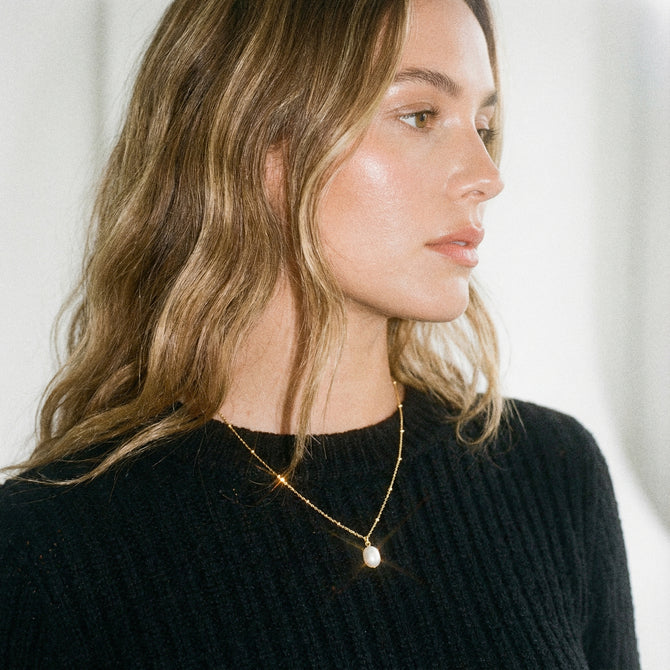
Adds a delicate pearl focal point for layered looks.
![{"image_loaded": true, "load_issue": null, "description": "The image shows a woman with medium-length brown hair looking into a mirror and adjusting a green earring on her left ear. She wears a mauve long-sleeved top and a matching necklace with round green beads of varying sizes. The setting appears to be indoors with neutral-colored walls and soft lighting from a pendant lamp above her head, partially visible in the mirror reflection. The camera angle is close-up, focusing on her face and upper torso, with the mirror capturing both her profile and her reflection. The background is blurred, placing emphasis on the woman and her jewelry.", "people": {"count": 1, "roles": ["individual"], "visible_demographics": "adult woman, approximate age mid-20s to 30s", "attire": "mauve long-sleeve top, green bead necklace, matching green bead earrings", "pose_or_activity": "looking into a mirror, adjusting earring"}, "setting": {"environment_type": "indoor", "location_hints": "neutral-colored walls, pendant lamp overhead, blurred background suggesting a home or studio environment", "depth_scale": "close-up", "lighting": "soft, diffused artificial light from above", "temperature": "neutral"}, "objects": {"primary_objects": ["green bead earrings", "green bead necklace"], "secondary_objects": ["pendant lamp", "mirror"], "object_interaction": "woman touching and adjusting earring"}, "composition": {"subject_focus": "woman's face and jewelry centered, reflected in mirror", "relationships": "foreground woman and her mirror reflection", "depth_structure": "shallow depth of field with blurred background", "camera_angle": "eye-level", "cropping": "close-up framing facial features and upper torso"}, "motion": {"motion_type": "implied", "motion_direction": null, "energy_level": "low", "sequence_implied": "single moment"}, "aesthetic": {"medium": "photograph", "style_subtype": "realistic", "color_palette": "muted, neutral tones with green jewelry accents", "contrast_level": "moderate", "texture_and_grain": "smooth", "postprocessing": "natural coloring with soft lighting"}, "tone": {"visual_mood": "calm, contemplative", "lighting_influence": "soft and diffused, creating gentle shadows", "camera_distance_effect": "intimate and personal"}, "confidence": {"demographic_confidence": 0.8, "activity_confidence": 0.9, "setting_confidence": 0.85}}](https://cdn.shopify.com/s/files/1/0371/8817/3961/files/description_a_woman_with_short_dark_hair_is_looking_into_a_round_mirror_adjusting_a_green_earring_on_her_left_ear_she_is_wearing_a_mauve_long_sleeve_top_and_a_necklace_with_three_larg.webp?v=1771429811)
How to inspect necklace length, pearl size, clasp and drape
Begin by measuring and mapping each strand. Record the clasp-to-clasp length and the average bead or pearl diameter, then observe how the strand drapes on the wearer by laying pieces on a bead board or a soft cloth and marking the intended centre and clasp positions. Adjust spacer counts until the marked centre sits where you want it in relation to the collarbone or wrist. Use proportional spacing rather than fixed gaps: set inter-bead spacing as a fraction of the bead diameter — about a quarter to a half for a delicate, continuous line; roughly equal to the diameter for a noticeable separation; and greater than the diameter for a distinctly spaced rhythm. Apply the same ratio across matching necklaces and bracelets to maintain a harmonious, unified appearance.
Larger or heavier pearls will change a strand's drape and apparent spacing, so allow for increased centre-to-centre spacing or a slightly shorter finished length. When mixing sizes, graduate the spacing toward the focal point to reinforce the graduated effect. Include clasps and connectors in your spacing decisions and test with the actual clasp attached or a temporary link or extension chain, since low-profile clasps sit flatter while bulkier or off-centre clasps can shift the visual centre. Use simple tools and tests to confirm cohesion: measure bead diameters with calipers or a small ruler, mock up spacers on cord or soft wire, then wear and photograph the piece at eye level and from typical movement angles to reveal any uneven gaps. Repeat adjustments until the spacing reads consistent both in photos and on the wearer, and consider a small repeating spacer element to unite necklaces and bracelets visually.
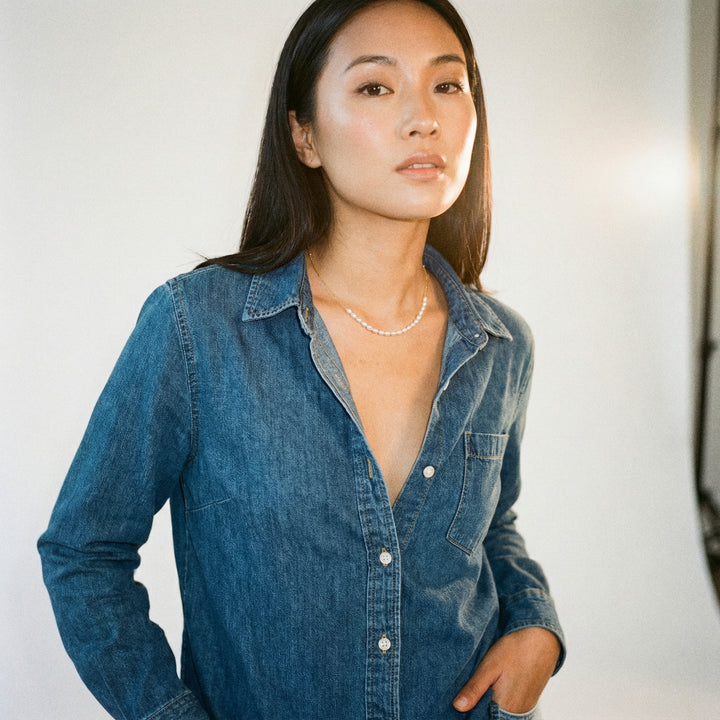
Choose a meticulously strung 18" strand for perfect drape.
![{"image_loaded": true, "load_issue": null, "description": "The image shows two women seated at a marble table examining pieces of jewelry. The woman on the left has blonde hair and wears a white blazer, holding a ring with black painted nails. The woman on the right has light brown or reddish hair and is holding a small jewelry item, wearing a light-colored long-sleeved top with a collared shirt underneath. On the table lie a gold necklace with red bead accents and a gold filigree ring on a beige cloth with branding. Behind them, there is a shelving unit displaying several pairs of shoes and a yellow shopping bag.", "people": {"count": 2, "roles": ["customers or clients"], "visible_demographics": "Two adult women, one blonde and one with light brown or reddish hair", "attire": "White blazer on the blonde woman; layered tops including a collared shirt on the other woman", "pose_or_activity": "Seated, closely examining and holding pieces of jewelry"}, "setting": {"environment_type": "indoor", "location_hints": "Marble table, shelving with shoes and shopping bag in background, well-lit interior", "depth_scale": "medium", "lighting": "soft, natural or diffused artificial lighting", "temperature": "neutral"}, "objects": {"primary_objects": ["gold necklace with red beads", "gold decorative ring", "another ring held by woman"], "secondary_objects": ["marble table", "beige branded cloth", "shelving with shoes", "yellow shopping bag"], "object_interaction": "Both women are holding and inspecting rings, jewelry pieces laid out on table"}, "composition": {"subject_focus": "Hands and jewelry on table, part of women\u2019s torsos and faces partially visible", "relationships": "Women are closely positioned indicating shared focus on jewelry", "depth_structure": "Foreground hands and jewelry sharp, background shelving softly out of focus", "camera_angle": "eye-level close-up, slight tilt down", "cropping": "half-body crop including arms and some facial area"}, "motion": {"motion_type": "static", "motion_direction": null, "energy_level": "low", "sequence_implied": "single moment"}, "aesthetic": {"medium": "photograph", "style_subtype": "realistic", "color_palette": "muted neutrals with gold accents", "contrast_level": "moderate", "texture_and_grain": "smooth", "postprocessing": "natural color grading"}, "tone": {"visual_mood": "calm, professional", "lighting_influence": "soft, even lighting enhances detail visibility", "camera_distance_effect": "intimate, focused on hands and jewelry"}, "confidence": {"demographic_confidence": 0.9, "activity_confidence": 0.95, "setting_confidence": 0.85}}](https://cdn.shopify.com/s/files/1/0371/8817/3961/files/two_women_examining_luxury_jewelry_on_a_marble_table_in_a_boutique_SP5A7n2Qks_e8c7bcc1-db1b-49c4-93ed-ce067f7e88b7.webp?v=1767508406)
How to layer necklaces and place pendants for effortless balance
For an effortless layered look, begin with a single focal pendant and add supporting chains at staggered lengths, aiming for about 2 to 4 centimetres of vertical separation so the pendants do not overlap when you stand naturally. Mix chain weights and textures to prevent tangling and introduce visual contrast; pair a fine, delicate chain with a medium-weight one, and position different clasp types or pendant bails so each piece moves independently. Try each length against the collarbone to check where the pieces sit, then fine-tune placement with removable extenders or a small knot at the back of the neck.
Use proportion as your guide: select a centrepiece no wider than the space between your collarbones, and reduce pendant size as chain length increases so visual weight remains balanced along the neckline. Create a gentle visual rhythm by repeating a small motif, alternating shapes or varying the spacing between pendants to lead the eye. Photograph the layered arrangement at arm's length to spot overlaps, then shorten or lengthen chains until each pendant reads distinctly. Carry that continuity into bracelets and other accessories by echoing motif, texture or spacing so the whole set feels cohesive.
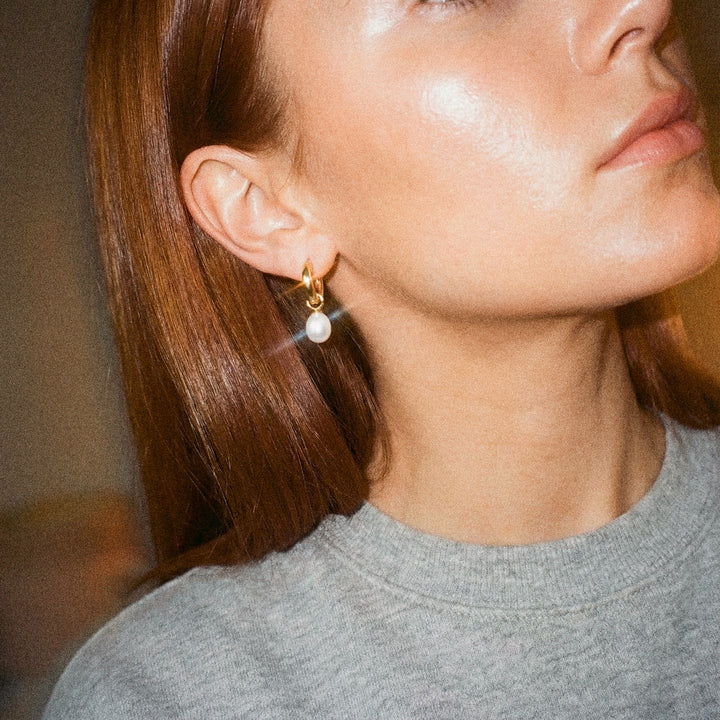
Add a muted pearl pendant for layered contrast.
![{"image_loaded": true, "load_issue": null, "description": "The image shows one man standing behind a glass display case filled with various jewelry pieces. The man, with short dark curly hair and a beard, is wearing a cream-colored, short-sleeve, button-up shirt with thin vertical black stripes. He is focused on working with a small jewelry tool in his hands. Behind him, there are multiple display boards holding earrings and bracelets, organized neatly on a wooden wall. The scene is brightly lit with warm-toned lighting.", "people": {"count": 1, "roles": ["jeweler or salesperson"], "visible_demographics": "adult male with short dark curly hair and beard", "attire": "cream-colored short-sleeve button-up shirt with vertical thin black stripes", "pose_or_activity": "working with a jewelry tool on a small piece of jewelry"}, "setting": {"environment_type": "indoor retail jewelry store", "location_hints": "wooden display boards with earrings and bracelets, glass jewelry display case", "depth_scale": "medium", "lighting": "warm artificial lighting", "temperature": "warm"}, "objects": {"primary_objects": ["small jewelry pieces in display case", "jewelry display boards with earrings and bracelets", "jewelry tool held by man"], "secondary_objects": null, "object_interaction": "man handling a small piece of jewelry using a tool"}, "composition": {"subject_focus": "man centered in frame, upper body visible", "relationships": "man positioned behind jewelry display; jewelry pieces in foreground and background", "depth_structure": "foreground jewelry display case in focus with background displays visible", "camera_angle": "eye-level", "cropping": "medium shot from waist up"}, "motion": {"motion_type": "implied", "motion_direction": null, "energy_level": "low", "sequence_implied": "single moment"}, "aesthetic": {"medium": "photograph", "style_subtype": "realistic", "color_palette": "warm, natural tones", "contrast_level": "moderate", "texture_and_grain": "clear, smooth focus", "postprocessing": null}, "tone": {"visual_mood": "focused, professional", "lighting_influence": "bright, warm illumination", "camera_distance_effect": "intimate, close enough for detail"}, "confidence": {"demographic_confidence": 0.9, "activity_confidence": 0.85, "setting_confidence": 0.9}}](https://cdn.shopify.com/s/files/1/0371/8817/3961/files/a_bearded_jeweller_inspects_jewelry_in_a_shop_showcasing_his_craft_and_expertise_SP5A7n2Qks.webp?v=1767767786)
How to stack bracelets for effortless, elegant wrist styling
Choose a dominant bracelet as an anchor, then add slimmer pieces either side, leaving gaps roughly equal to the narrowest bracelet so each element remains distinct and contact between pieces is minimised. Alternate texture, width and motif, pairing smooth, braided and beaded surfaces, and repeat a metal colour or motif every other piece to establish visual rhythm without clutter. Introduce one or two deliberate gaps so skin shows between bracelets; this highlights the focal pieces and reduces tangling during movement.
Allow for movement and comfort by positioning bracelets so each can slide independently; avoid sitting them too close to the wrist bone to prevent bunching and abrasion. Choose adjustable styles, extender chains, spacer beads or a slim cuff to fine-tune spacing so the stack sits consistently when you bend your wrist. Repeat the same spacing across both wrists and echo necklace spacing or a repeating motif to create a cohesive finish. These small adjustments make combinations easy to recreate and help keep proportions balanced between necklaces and bracelets.
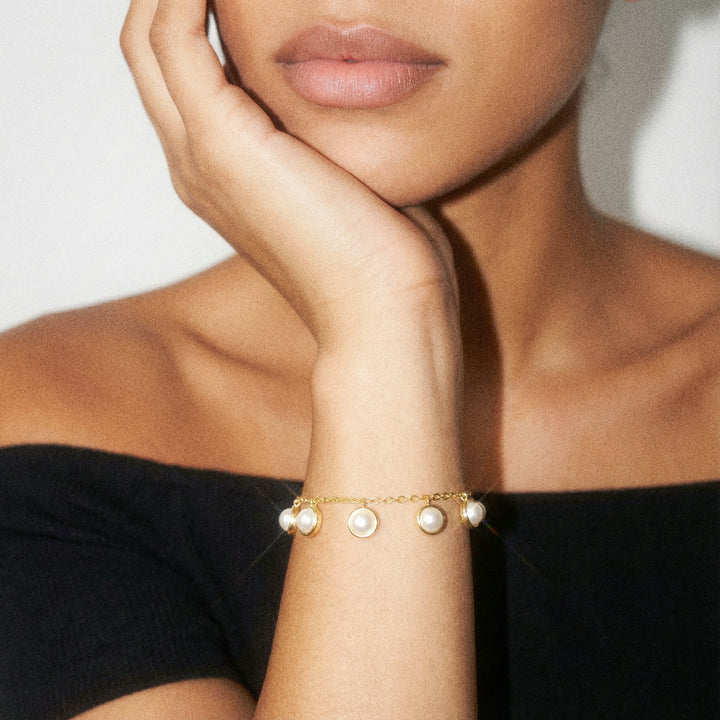
Choose a chunky, pearl-accented link as your anchor.
![{"image_loaded": true, "load_issue": null, "description": "The image shows a young adult woman seated indoors on a chair with a cane backrest. She is positioned in front of three tall, narrow windows with sheer white curtains that diffuse bright daylight. The woman is in profile facing right, with long wavy brown hair and light skin tone. She wears a sleeveless black dress with a low neckline and multiple pearl necklaces of varying lengths around her neck and draped down her chest. Her right hand is raised near her neck, lightly touching one of the necklaces. The background is a softly lit white interior wall and window frames, with some blurred urban architecture visible outside through the windows.", "people": {"count": 1, "roles": ["model"], "visible_demographics": "young adult female, light skin tone, brown hair", "attire": "black sleeveless dress, multiple pearl necklaces", "pose_or_activity": "seated, profile view, touching necklace with right hand"}, "setting": {"environment_type": "indoor", "location_hints": "white wall with tall windows, sheer curtains, cane-back chair, urban scene faintly visible outside", "depth_scale": "medium", "lighting": "bright natural light from windows, diffused", "temperature": "neutral"}, "objects": {"primary_objects": ["pearl necklaces", "black dress", "chair"], "secondary_objects": ["window curtains", "window frames"], "object_interaction": "woman touching pearl necklaces"}, "composition": {"subject_focus": "woman centered but positioned to the right side of frame", "relationships": "woman seated in front of windows, necklace draws attention to upper body", "depth_structure": "shallow depth of field, woman sharply in focus, background softly blurred", "camera_angle": "eye-level", "cropping": "medium shot from waist up"}, "motion": {"motion_type": "static", "motion_direction": null, "energy_level": "low", "sequence_implied": "single moment"}, "aesthetic": {"medium": "photograph", "style_subtype": "realistic", "color_palette": "muted neutrals with dark dress and white pearls", "contrast_level": "moderate", "texture_and_grain": "smooth", "postprocessing": "natural lighting, slight diffusion from window"}, "tone": {"visual_mood": "calm, refined", "lighting_influence": "soft, diffused bright light", "camera_distance_effect": "intimate, personal"}, "confidence": {"demographic_confidence": 0.9, "activity_confidence": 0.95, "setting_confidence": 0.9}}](https://cdn.shopify.com/s/files/1/0371/8817/3961/files/image_loaded_true_load_issue_null_description_the_image_shows_a_young_woman_sitting_indoors_in_front_of_a_large_window_with_white_framing_she_is_wearing_a_sleeveless_black_dress_with_148f1595-b3c9-4234-b96f-0fb1a8d77e64.webp?v=1769596436)
Harmonise neck and wrist through balance, colour, texture, movement, and comfort
When coordinating necklaces and bracelets, use simple measurement rules to keep each piece distinct. Leave around 3 to 7 centimetres between necklace focal points to prevent overlap, and allow one finger's width between a bracelet and the wrist for comfortable movement; space wider bracelets farther apart than narrow ones. Create visual rhythm by repeating a metal, colour or texture at least twice across the ensemble, alternate smooth and textured pieces for contrast, and place small pops of colour on both neck and wrist to draw the eye. Use scale and hierarchy to direct attention by choosing a single anchor piece and then adding supporting items of smaller visual weight so nothing competes. As a practical rule, match a large pendant with either one chunky bracelet or two to three delicate bracelets, and pair dainty necklaces with tighter, minimal bracelet stacks.
Prevent tangles and rubbing by staggering pendant positions so they sit on different vertical planes, positioning bracelet clasps away from the hand, and using small spacer beads, sliding knots or stopper rings to keep lightweight chains and charms apart. Before you head out, run a brief check: photograph the arrangement from chest to wrist, move your arms naturally and listen for rubbing or noise. If any piece shifts or catches, adjust lengths with an extender, add spacer beads, or swap in an item with a different profile until the set settles and moves with ease.
Coordinated spacing and considered proportion elevate layered necklaces and stacked bracelets from clutter to a cohesive statement. Measure clasp-to-clasp lengths, set gaps between beads to a fraction of each bead's diameter, and stagger pendants so each piece sits independently and helps prevent tangling.
Use the guide's steps to balance proportions, check length and drape, position pendants with intention and allow breathing space in bracelet stacks to create a harmonious rhythm between neck and wrist. Test combinations on the body, photograph them, and refine with extenders or spacer beads. Keep the arrangements that read consistently in photographs and movement as your default for future layering.