

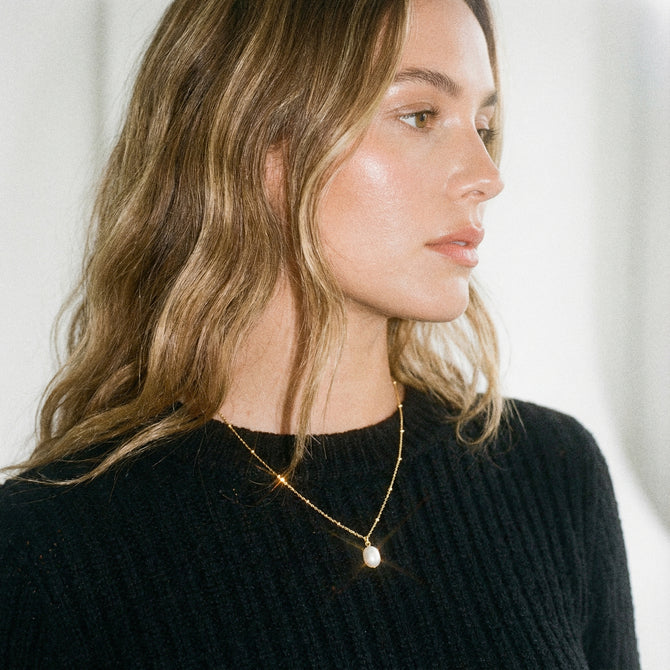
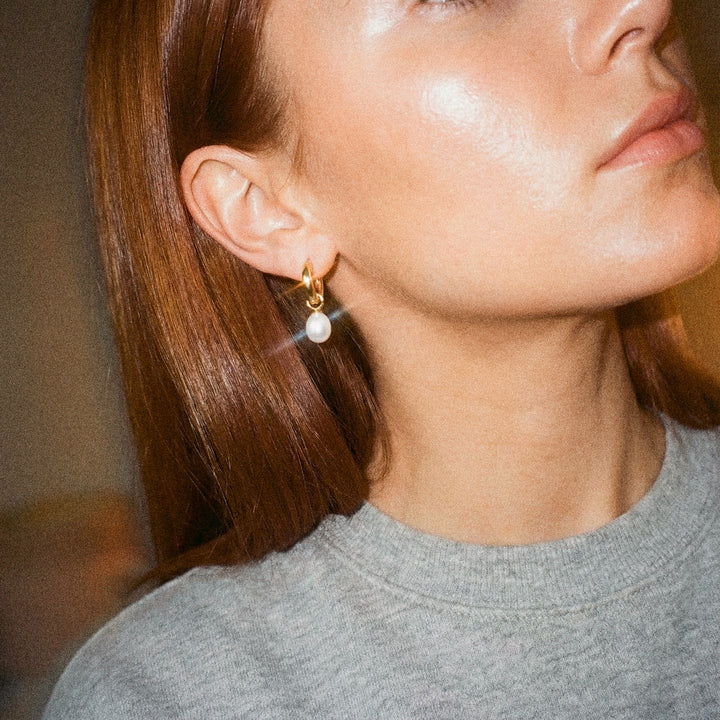
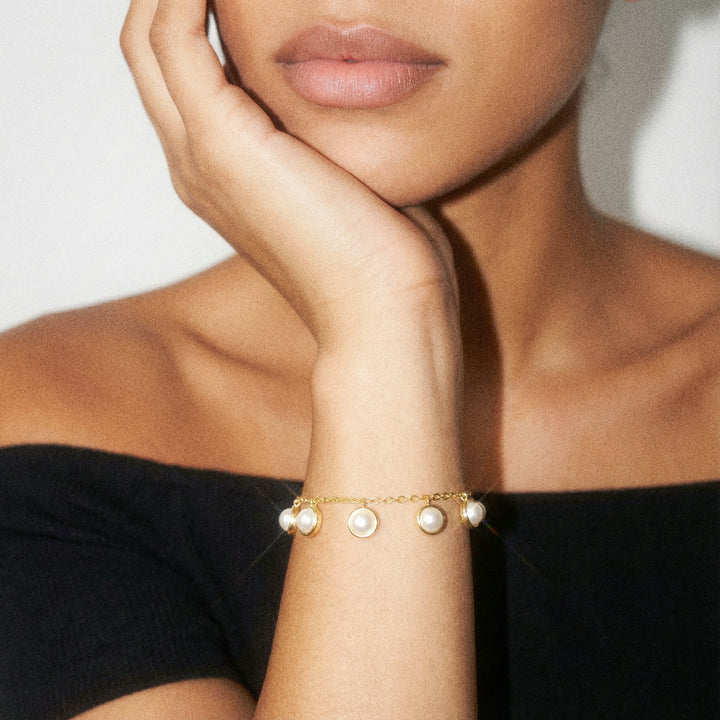
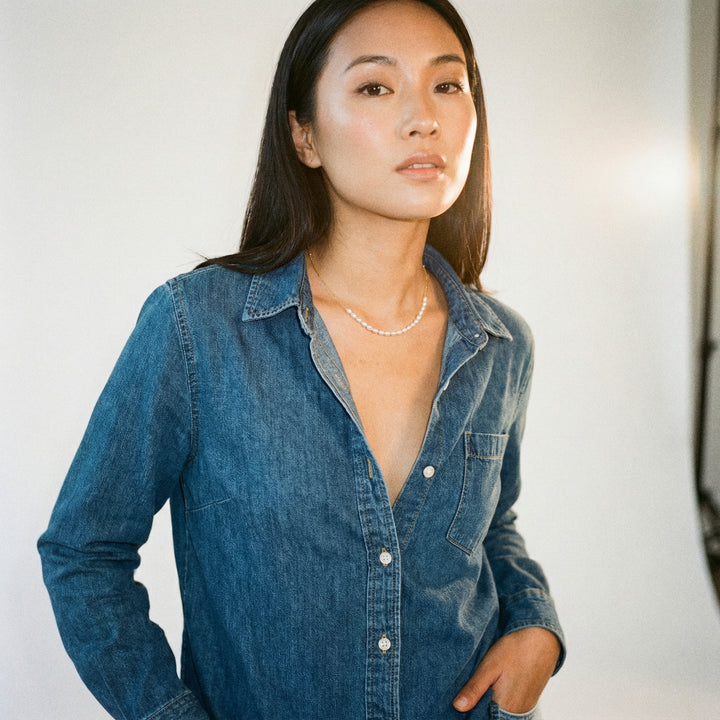


Choosing pearl studs can feel straightforward until you consider size and placement in relation to your face and hairstyle. The right size, whether petite or more substantial, together with hair length, volume and parting, can balance proportions and subtly change how your features are perceived.
Small adjustments, such as switching to a side part, tucking hair behind the ear or choosing larger studs, can subtly change the perceived width and length of the face. This guide will help you identify your face shape, choose a pearl size to suit your proportions and provide practical hairstyle and placement tips to create harmonious, personalised looks.
![{"image_loaded": true, "load_issue": null, "description": "An indoor portrait of a young woman wearing an ornate white dress with puffed sleeves and intricate embroidery. She has pearl earrings and a pearl necklace. The woman is looking to the right side with a contemplative expression. Behind her, there is an ornate mirror reflecting part of her image and a decorative wrought iron design. The wall has a textured, patterned surface and there are bare branches on the right side of the frame. Light is coming from the right, casting soft shadows and highlighting the details of her dress and face.", "people": {"count": 1, "roles": ["model"], "visible_demographics": "One young adult woman with medium complexion and curly hair styled in a loose updo", "attire": "White, long-sleeved, embroidered dress with puffed sleeves, pearl necklace, and earrings", "pose_or_activity": "Standing still, arms gently crossed, looking contemplatively to the right"}, "setting": {"environment_type": "indoor", "location_hints": "ornate mirror with wrought iron design, patterned wallpaper, bare branch decoration, soft natural light from right side", "depth_scale": "medium", "lighting": "soft natural light from side, casting gentle shadows", "temperature": "neutral"}, "objects": {"primary_objects": ["ornate mirror", "bare branches"], "secondary_objects": ["pearl necklace", "pearl earrings"], "object_interaction": "The person is positioned in front of the mirror but not interacting directly with objects"}, "composition": {"subject_focus": "subject placed slightly right of center in frame", "relationships": "mirror behind subject showing partial reflection, branches off to right side", "depth_structure": "mid-ground depth with clear separation between subject and background", "camera_angle": "eye-level", "cropping": "waist-up shot"}, "motion": {"motion_type": "static", "motion_direction": null, "energy_level": "low", "sequence_implied": "single moment"}, "aesthetic": {"medium": "photograph", "style_subtype": "realistic, soft-focused portrait", "color_palette": "muted, neutral tones with white dress as focal color", "contrast_level": "moderate", "texture_and_grain": "soft, smooth textures emphasizing fabric details", "postprocessing": "natural color grading with subtle desaturation"}, "tone": {"visual_mood": "calm, contemplative, elegant", "lighting_influence": "soft, diffused side lighting creates shadows and highlights", "camera_distance_effect": "intimate but not close-up"}, "confidence": {"demographic_confidence": 0.9, "activity_confidence": 0.95, "setting_confidence": 0.9}}](https://cdn.shopify.com/s/files/1/0371/8817/3961/files/upload_509c9e9e-25d5-4f4d-a3d0-de9a9d93cd79.webp?v=1764919556)
How to identify your face shape and signature features
Begin with two photographs: one taken straight-on and one in profile. Compare forehead, cheekbones, jawline and face length to identify whether your shape is round, oval, square, heart or long, and use a simple checklist to confirm which dimension is most prominent. Make a note of forehead height and hairline, the prominence of cheekbones, jaw angle and chin point, plus neck length and ear placement including earlobe type, as these subtleties affect perceived proportions and whether studs will accentuate or soften particular planes. Next, try three straightforward hairstyle variations — sweep the hair back, wear it down with a centre part, and pin it behind one ear. Photograph each look and observe how studs sit against the face to see whether crown or side volume lengthens or broadens your silhouette.
As a general guide, larger stud earrings add apparent width and draw the eye, so choose them to balance a long face or an angular jaw. Smaller studs minimise added width and suit wider faces or more delicate bone structure. Make deliberate exceptions: pair a larger stud with an updo to create a refined focal point that does not compete with the cheekbones, or wear a small stud with hair tucked behind the ear to emphasise a longer neck. When testing, consider earlobe size and placement, compare how studs look with hair tucked versus hair covering the ear, and study photographs for cues such as symmetry, the apparent length of the neck, or whether a stone competes with the cheekbones. Use these observations to decide final placement and parting.
Try classic button pearls for a refined, balanced finish
![{"image_loaded": true, "load_issue": null, "description": "The image shows a middle-aged woman standing indoors in front of a mirror. She is adjusting an earring and looking at her reflection. The woman has light brown hair and is wearing a white button-up blouse and high-waisted gray trousers. The setting appears to be a bedroom or personal space, with a partially visible bed and lamp in the background. The lighting is soft and natural, coming from the right side, creating a calm atmosphere. Framed artwork hangs on the wall behind her, and a cozy environment is suggested by the visible bed linens and lighting.", "people": {"count": 1, "roles": ["individual preparing"], "visible_demographics": "middle-aged adult female", "attire": "white button-up blouse, gray pants", "pose_or_activity": "adjusting earring while looking in mirror"}, "setting": {"environment_type": "indoor, bedroom or personal space", "location_hints": "bed with headboard, bedside lamp, framed artwork on wall", "depth_scale": "medium", "lighting": "soft natural light from right side, warm and even", "temperature": "neutral"}, "objects": {"primary_objects": ["mirror"], "secondary_objects": ["bed", "table lamp", "framed artwork", "clothing"], "object_interaction": "woman adjusting earring in front of mirror"}, "composition": {"subject_focus": "woman centered in mirror reflection", "relationships": "mirror reflection frames the woman; background elements softly blurred", "depth_structure": "shallow depth of field emphasizing woman and mirror", "camera_angle": "eye-level", "cropping": "medium shot including upper body and mirror frame"}, "motion": {"motion_type": "implied", "motion_direction": null, "energy_level": "low", "sequence_implied": "single moment"}, "aesthetic": {"medium": "photograph", "style_subtype": "realistic", "color_palette": "muted neutrals with soft warm tones", "contrast_level": "moderate", "texture_and_grain": "smooth", "postprocessing": "natural lighting, minimal editing"}, "tone": {"visual_mood": "calm, introspective", "lighting_influence": "soft and warm", "camera_distance_effect": "intimate and personal"}, "confidence": {"demographic_confidence": 0.8, "activity_confidence": 0.9, "setting_confidence": 0.85}}](https://cdn.shopify.com/s/files/1/0371/8817/3961/files/image_loaded_true_load_issue_null_description_a_woman_standing_indoors_in_front_of_a_mirror_adjusts_her_earring_she_has_shoulder_length_light_brown_hair_and_wears_a_white_blouse_tucke_3a4c5cb4-e664-43ec-bc30-c24edf444718.webp?v=1769215098)
Balance your features with small and large pearl studs
Choose a stud size that balances your facial proportions. Smaller pearls suit narrow or oval faces as they avoid overwhelming the features, while larger pearls complement rounder or broader faces by creating a focal point that visually lengthens or balances. Consider earlobe size and placement: position smaller pearls closer to the facial centre so they are not lost against the cheek, and allow larger pearls to sit slightly further out on the lobe to prevent crowding. View both the front and three-quarter angles in a mirror or in photographs to assess how scale and placement read from different perspectives. Use your hairstyle to frame the face so each stud remains visible.
Use your hairstyle to control visibility and perceived scale. Pull hair back or tuck it behind the ear to make small pearls more visible, or pair larger studs with added volume or a half-up style so earring and hair share similar visual weight. Rounded pearls sit naturally with soft, flowing hair, while side-swept bangs or an asymmetrical cut will soften a strong jawline and allow the studs to act as a balanced focal point. Consider comfort too: heavier pearls can tug at the lobes and change how hair frames the ear, so secure hair away from the ear, wear the studs during normal movement, and adjust placement or style to keep them centred and comfortable.
Switch between subtle and statement looks effortlessly.
![{"image_loaded": true, "load_issue": null, "description": "The image shows a young woman in profile standing outdoors near a bench in an urban setting. She is wearing a long white coat and sheer black polka dot gloves, with her hair tied back with a scrunchie. Large pearl drop earrings and a scarf around her neck are also visible. The background features a multi-story building with cream and green walls and multiple windows. The lighting suggests overcast or late-day conditions, and the overall color palette is muted and natural. The camera angle is eye-level with a medium distance, isolating the subject from the background with moderate depth of field.", "people": {"count": 1, "roles": ["fashion model"], "visible_demographics": "female, young adult", "attire": "white coat, sheer black polka dot gloves, scarf, large pearl earrings", "pose_or_activity": "standing in profile, hand raised lightly to shoulder"}, "setting": {"environment_type": "outdoor urban", "location_hints": "bench, multi-story building with windows, overcast sky", "depth_scale": "medium", "lighting": "natural, diffused, soft", "temperature": "neutral"}, "objects": {"primary_objects": ["white coat", "black gloves", "pearl earrings", "scarf"], "secondary_objects": ["bench"], "object_interaction": "woman touching her coat shoulder with gloved hand"}, "composition": {"subject_focus": "medium frame, side profile of woman positioned center-left", "relationships": "woman in foreground, building and bench in background", "depth_structure": "moderate depth of field, background slightly blurred", "camera_angle": "eye-level", "cropping": "medium shot"}, "motion": {"motion_type": "static", "motion_direction": null, "energy_level": "low", "sequence_implied": "single moment"}, "aesthetic": {"medium": "photograph", "style_subtype": "realistic", "color_palette": "muted, natural tones", "contrast_level": "moderate", "texture_and_grain": "smooth", "postprocessing": "subtle color grading enhancing warm and neutral tones"}, "tone": {"visual_mood": "calm, contemplative", "lighting_influence": "soft, diffused natural light", "camera_distance_effect": "intimate and focused on subject"}, "confidence": {"demographic_confidence": 0.9, "activity_confidence": 0.8, "setting_confidence": 0.85}}](https://cdn.shopify.com/s/files/1/0371/8817/3961/files/upload_7af5d866-80bb-4afd-9bc6-f6b3c57b1c5c.webp?v=1766040049)
Adjust hair length, volume and parting to frame stud earrings
Start with proportion: compare the pearl’s diameter to the visible width of your earlobe or to the size of your iris in a mirror, then choose a hairstyle that keeps that relationship clear. Small studs work best with short cuts, tucked hair or sleek updos; larger pearls are more effective with pulled-back styles or a one-sided reveal so they do not compete with heavy hair. Manipulate volume to balance the face. Add height at the crown to elongate a round face, introduce soft jawline volume with waves or layers to counter a heart-shaped forehead, and soften sharp angles on a square face with loose texture. These subtle shifts change how prominently a stud reads against the silhouette. Use the parting to direct attention. A centre part emphasises symmetry and shows both studs, a deep side part concentrates the gaze on one ear, and sweeping hair to the opposite side while tucking the exposed ear instantly increases a stud’s visibility. Match hair length and layers to stud placement. Keep face-framing layers ending at or just above the earlobe for small studs so they remain visible. Allow longer layers to fall below the jaw for larger pearls, giving the gem clear space, or choose a cropped or tucked style when the earlobe is small to avoid the stud being swallowed by hair.
Adopt a few simple, repeatable techniques to reveal stud earrings with confidence. Gather the hair into a low bun or chignon to showcase larger pearls; pull the front sections into a half-up twist to reveal medium studs while keeping natural movement; or tuck one side behind the ear or secure it with a small clip to keep smaller studs on show during busy days. Make sure the reveal is secure so the earring does not become covered, helping the look remain balanced as you move. Try combinations in a mirror and adjust the parting, volume or length until the pearl sits in proportion with your earlobe and overall silhouette.
Choose classic button pearls for easy, balanced ear styling.

Match pearl size to your face shape: hairstyle examples
For round faces, favour small to medium pearls that do not add visual width, and pair them with sleek low buns, long straight hair or side-swept layers to create a more elongated silhouette. Oval faces suit most pearl sizes, so focus instead on hairstyle shape: high ponytails, soft waves or tucking hair behind the ear help to showcase studs. These combinations rely on vertical lines and neat hair placement to balance proportions without overwhelming the features.
Square faces suit medium to larger pearls, which help soften an angular jawline, and work especially well with loose chignons, curtain bangs or shoulder-length waves. For heart-shaped faces, small to medium pearls worn lower on the earlobe help balance a narrower chin and complement low buns, long side parts or pixie cuts. Long or oblong faces often benefit from larger pearls or a pairing of studs with voluminous hair; layered waves, a bob or textured updos create useful horizontal balance. Adjust pearl size, placement and hair volume to direct the eye horizontally or vertically, letting studs enhance the natural bone structure rather than compete with it.
Framed pearl studs balance and showcase your profile.
![{"image_loaded": true, "load_issue": null, "description": "The image shows the back of a person with dark, straight hair tied in a low ponytail against a solid dark blue background. The person is wearing a white sleeveless top and is adorned with multiple strands of pearls around the neck, as well as pearl earrings and a necklace with a single pearl pendant. The skin tone is medium, and the frame captures from the upper back to the head, with hair and accessories in clear focus.", "people": {"count": 1, "roles": ["model"], "visible_demographics": "adult, female-presenting", "attire": "white sleeveless top", "pose_or_activity": "standing with back to camera, head turned slightly to the side"}, "setting": {"environment_type": "studio indoors", "location_hints": "plain dark blue backdrop", "depth_scale": "close-up", "lighting": "soft, diffused studio lighting", "temperature": "neutral"}, "objects": {"primary_objects": ["pearl necklaces", "pearl earrings", "pearl pendant necklace"], "secondary_objects": null, "object_interaction": "wearing jewelry"}, "composition": {"subject_focus": "centered on back of head and upper back", "relationships": "pearls draped on shoulders and neck", "depth_structure": "shallow depth of field with clear focus on hair and jewelry", "camera_angle": "eye-level, rear view", "cropping": "close-up from shoulders up"}, "motion": {"motion_type": "static", "motion_direction": null, "energy_level": "low", "sequence_implied": "single moment"}, "aesthetic": {"medium": "photograph", "style_subtype": "realistic, minimalist", "color_palette": "neutral skin tones with white pearls against dark blue background", "contrast_level": "moderate", "texture_and_grain": "smooth, soft-lit skin and shiny pearls", "postprocessing": "natural color grading, no heavy filters"}, "tone": {"visual_mood": "calm, elegant", "lighting_influence": "soft, even light reduces shadows", "camera_distance_effect": "intimate, focused on jewelry details"}, "confidence": {"demographic_confidence": 0.85, "activity_confidence": 0.9, "setting_confidence": 0.9}}](https://cdn.shopify.com/s/files/1/0371/8817/3961/files/description_the_image_shows_the_back_of_a_person_with_medium_dark_hair_styled_in_a_tied_back_fashion_facing_a_solid_navy_blue_background_they_are_wearing_a_white_sleeveless_top_or_dre.webp?v=1768977039)
How to optimise proportion, placement and complementary styling
Choose pearl size with proportion in mind, matching each stud to the width of your face and the size of your earlobes so it feels part of your silhouette rather than a distraction. As a simple guide, very small pearls flatter delicate faces and short lobes; medium pearls suit average proportions; larger pearls balance a stronger bone structure. Hold each size at eye level to judge its visual weight. Consider placement too: moving the centre of a stud slightly higher shortens a long neck, while a lower position creates a gentle elongation. Pin back your hair and photograph at chin level to see how the studs sit.
Match hairstyle texture and parting to the scale of the pearls. Sleek, pulled back styles allow larger pearls to become the centrepiece, while looser, textured hair complements smaller or mid-sized studs that catch the light without being lost. Tailor choices to face shape: slightly larger pearls and vertical styling suit round faces; proportionate studs flatter oval faces; rounder pearls with soft waves help soften square features; and lower placement with side-swept hair balances heart-shaped faces. Coordinate the rest of the look by simplifying necklaces and necklines when wearing large studs, choosing metal tones that flatter your complexion, and testing one change at a time. Photograph each variation to see which combination best directs attention where you intend.
Matching pearl size and placement to hair length, volume and parting helps to balance the face and create a clear focal point. Photograph simple trials from the front and three quarter angles, and compare how different stud positions sit against the earlobe to see which combinations appear most harmonious.
Use the face-shape guidelines, hairstyle examples and placement tips in this post to refine your choices, helping you soften, elongate or draw the eye to the areas you prefer. Change only one variable at a time, photograph each variation, and choose the option that best complements your bone structure and natural movement.