



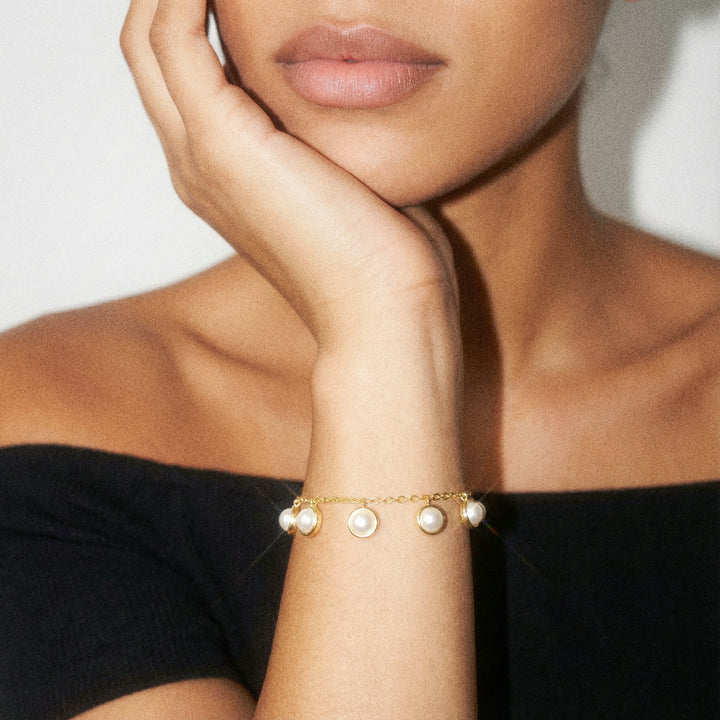



Selecting pearls can sometimes seem complex, with lustre, shape, and surface quality each offering their own nuances. Understanding how to assess cultured pearls ensures a choice that remains both elegant and enduring.
This guide explores the nuances of pearl types and their formation, the carefully managed stages of cultivation, the artistry involved in harvesting and grading, and the refined finishing techniques that shape each strand. With thoughtful pointers for inspection and care, you will be well-equipped to appreciate quality, recognise important characteristics, and select pearls with assurance.
![{"image_loaded": true, "load_issue": null, "description": "A close-up image of two hands working on a jewelry ring. The fingers holding the ring are dirty and rough, indicating manual labor. The ring being held is silver and features a detailed, intricate design with prongs around its circumference. The background is dark and blurred, focusing attention on the hands and the ring, with a worn workbench surface partially visible.", "people": {"count": 1, "roles": ["jeweler", "craftsman"], "visible_demographic](https://cdn.shopify.com/s/files/1/0371/8817/3961/files/image_loaded_true_load_issue_null_description_a_close_up_image_of_two_hands_working_on_a_jewelry_ring_the_fingers_holding_the_ring_are_dirty_and_rough_indicating_manual_labor_the_ring_9df60b30-ff6b-4964-9c69-f39e606c3b12.webp?v=1770738299)
Exploring the Different Types of Pearls and Their Formation
Pearls are created within molluscs as layers of lustrous nacre gently encase a natural irritant. While natural pearls form without any human influence, cultured pearls arise when a carefully selected material is introduced to encourage nacre development. Some imitations, however, are crafted from glass or plastic and lack the natural beauty of genuine pearls. Cultured pearls are produced using two main techniques: bead nucleation, where a solid core is enveloped by concentric nacre layers, and tissue grafting, which results in pearls composed entirely of nacre. Experts often rely on X-ray imaging or independent laboratory assessments to distinguish between these methods. When assessing pearls, a magnification of 10x can help reveal the quality of lustre, the subtlety of overtones, the uniformity of shape, and any natural surface marks. Examining the drill hole may reveal a bead shadow or the characteristic layering of nacre. Observing how a pearl reflects light is also telling; pearls with a deep, mirror-like sheen often possess a thicker nacre and a more captivating presence.
Distinct pearl culturing methods impart unique characteristics. Bead-nucleated saltwater pearls are typically more rounded with defined overtones, while tissue-nucleated freshwater pearls often display solid nacre and a wider array of shapes and colours. Rather than relying solely on labels, consider the shape, colour, and longevity that best suit your personal preferences. Nacre thickness, influenced by growth duration, mollusc species, water purity, and cultivation practices, is a key factor in both lustre and durability. For those interested in longevity or potential resale, it is worthwhile to enquire about nacre measurements, growth methods, and species. When wishing to confirm such details, seek a recognised gemmological report or X-ray, along with clear provenance, and compare these documents with your own careful observations to make an informed judgement.
Choose sculptural freshwater pearls for a uniquely organic look
![{"image_loaded": true, "load_issue": null, "description": "The image shows a close-up section of a person\u2019s upper chest, neck, and hair. The person is wearing a white garment with a V-shaped neckline and a string of white pearls around their neck. Dark hair partially covers the neck and shoulder area. The background is blurred and neutral.", "people": {"count": 1, "roles": ["individual model"], "visible_demographics": "One adult person, gender presentation appears female, skin tone light to medium.", "](https://cdn.shopify.com/s/files/1/0371/8817/3961/files/image_loaded_true_load_issue_null_description_the_image_shows_a_close_up_section_of_a_person_u2019s_upper_chest_neck_and_hair_the_person_is_wearing_a_white_garment_with_a_v_shaped_nec_ede3f778-d7ac-4b36-9088-087ce55123b8.webp?v=1770738305)
From Oyster to Ornament: The Journey of Pearl Cultivation
The journey of a pearl begins with careful nucleation or tissue grafting, followed by a period of growth, gentle cleaning, and eventual harvest. Each stage subtly influences the character of the finished pearl: the size and type of nucleus help shape the pearl, while the length of growth enhances the depth of nacre and the lustre. Regular cleaning routines contribute to the pearl’s surface quality and the presence of any natural markings. For those wishing to assess pearls with care, it is advisable to request harvest notes, detailed close-up photographs, and X-ray images that reveal the structure of the nucleus and nacre layers. Asking for information on nacre thickness, often given in millimetres or shown through images of the drill hole or cross-section, can further illuminate the pearl’s quality.
The origins of a pearl, from the species of mollusc to the quality of the water and even the movement within the farm, delicately influence its colour, orient, and lustre. Subtle variations in these conditions shape the individuality of each gem. Pearls that have been allowed to grow over longer periods often reveal thicker nacre, resulting in a deeper lustre and enhanced durability, though this may introduce more natural surface characteristics. When evaluating pearls, consider those with documented nacre thickness for lasting elegance. It is also essential to understand any treatments a pearl may have undergone, such as bleaching or dyeing. Tell-tale signs may include uneven colour near the drill hole or subtle residues visible under magnification. When further clarity is needed, a professional gemmological report can provide valuable insight into both cultivation methods and any post-harvest enhancements.
Choose sculptural freshwater pearls that celebrate natural character.

What Sets Pearl Harvesting and Grading Apart?
Appreciating a pearl's journey from cultivation to completion involves understanding how nucleation methods, the skill of the grafter, and the growth period influence its shape, nacre depth, and surface finish. Bead-nucleated saltwater pearls typically derive their form from an inserted nucleus, whereas tissue-nucleated freshwater pearls generally develop a thicker, solid layer of nacre. For those considering pearls with particular qualities, it is advisable to enquire about the nucleation technique and any available nacre thickness records. When the structure or depth of nacre is of special interest, X-ray images can offer valuable insight into the internal characteristics, revealing both the placement of the nucleus and the layering of nacre.
Evaluate pearls with a discerning eye by observing their lustre under raking light and noting the unique iridescence, known as orient, that emerges from within each gem. Examine the surface using a 10x loupe, recording the size in millimetres and capturing high-quality images from various angles to appreciate their natural beauty. To understand the origins and care behind each pearl, enquire about harvesting methods, farm practices, and environmental standards, seeking supporting images where available. These details can offer insight into surface characteristics and overall quality. It is also wise to request clear information regarding any post-harvest treatments, such as bleaching or dyeing, and to be attentive to subtle markers like coating residue near drill holes. For further assurance, objective assessments from independent laboratories or X-ray analysis can provide valuable comparisons when considering your options.
Choose organic-shaped freshwater pearls for distinctive, natural lustre.

Exploring Artisan Techniques for Finishing Pearl Strands
Gently run the strand of pearls through your fingers, observing the knots between each pearl with care. Well-centred knots that rest closely against the pearls help prevent unnecessary friction and preserve the strand's integrity, while loose or uneven knots may indicate tension issues. To evaluate the quality of the thread, note the subtle lustre and gentle flexibility characteristic of silk, which contrasts with the firmer feel of synthetic alternatives. Take a closer look where the thread meets the clasp for any signs of fraying, discolouration, or excess adhesive. The overall elasticity and condition of the strand can also provide insight into when it might benefit from professional re-stringing.
Inspect the clasp and findings to ensure they reflect fine craftsmanship, with seamless joints and a secure, smoothly operating mechanism. When possible, examine these details with a magnifying glass to ensure there are no visible gaps or irregularities. Confirm that the metals used are well matched to the strand, as this helps preserve the piece's longevity. Holding the strand to the light can reveal the alignment of drill holes and the quality of their placement, while chips or uneven edges should be minimal, even on baroque pearls. Subtle traces of adhesive may suggest previous repairs and warrant closer attention. Finished details, such as neatly recessed crimps or discreetly concealed bead tips, are hallmarks of professional assembly. If a close inspection is not possible, request detailed images of these hidden endings. Above all, a well-strung strand should show even tension and harmonious spacing, allowing it to drape and move gracefully.
Opt for a finely strung pearl strand with sterling silver.

How to Select and Care for Pearls with Confidence
Cultured pearls are formed either around a bead nucleus or through tissue nucleation, with their lustre and durability determined by layers of calcium carbonate nacre, deposited by the mollusc in fine increments. Advanced methods such as X-ray analysis or laboratory reports can distinguish bead-nucleated pearls from those composed entirely of nacre. The thickness of the nacre is a reliable indicator of both lustre retention and longevity, offering an objective standard for assessing enduring quality. When examining pearls, it is advisable to observe them under diffused white light and gently rotate them to appreciate their orient and surface reflection. A 10x loupe may be used to inspect for blemishes and to evaluate the nacre around drill holes, while comparing similarly sized pearls side by side assists in assessing uniformity and matching.
For pieces intended for daily wear, select pearls with a thicker nacre and a radiant lustre. When choosing a necklace to be worn as a set, seek out pearls with harmonious colour and a consistently smooth surface. Opt for knotted silk thread and secure clasps to ensure lasting strength, and for more significant investments, request independent certification to confirm authenticity beyond appearance alone. After each use, gently wipe pearls with a soft, slightly damp, lint-free cloth to remove any traces of cosmetics or perspiration. Store them flat in a soft pouch, kept separate from other jewellery to prevent scratching. It is best to avoid exposing pearls to acids, perfume, or household cleaners. Periodically check the drill holes and string for signs of wear, and have them restrung when needed. Choosing low-profile or bezel settings for rings offers added protection from knocks. Remember, pearls are naturally delicate, but with attentive care and the possibility of professional restoration, their beauty can be gracefully preserved.
Evaluating pearls involves considering measurable aspects such as nacre thickness in millimetres, the nucleation process, and assessment techniques including loupe examination and X-ray imaging. These factors provide insight into lustre, durability, and craftsmanship based on tangible evidence. Supporting documentation, such as laboratory analyses, harvest records, and detailed imagery, can offer further clarity and facilitate objective comparison.
Refer to guidance on pearl types, formation, cultivation, harvesting, grading, artisan finishing, and care to inform your inspection and selection. Consider these aspects thoughtfully, seek authenticity in documentation where appropriate, and follow recommended care routines to ensure your chosen strand retains its luminous beauty and enduring wearability.